--:-- Shamita Basu: Good morning. It's Monday, November 18th. I'm Shamita Basu. This is Apple News Today.
--:-- Shamita Basu: On today's show, how the Department of Education became a political lightning rod. What happened in Florida when they appointed a vaccine skeptic to run public health. And the Alaska town that won't see sunrise again for 64 days. But first, President Joe Biden has given Ukraine approval to use U.S.-made weapons to strike deep into Russia for the first time.
--:-- Shamita Basu: That's according to at least two U.S. officials who tell Reuters that this is in direct response to North Korean ground troops joining the Russian offensive. And with just two months left in office, it marks a significant policy shift for President Biden, who has so far resisted giving Ukraine the green light to use these weapons out of fear that it could escalate the conflict.
--:-- Shamita Basu: In the past, Russia has called this a red line. And yesterday, senior Russian lawmakers said it could lead to World War III. The weapons, known as the Army Tactical Missile System, can travel about 190 miles and would allow Ukraine to strike Russian ammunition depots, logistical centers, basically anything that would allow them to resupply their front line.
--:-- Shamita Basu: Here's how retired Air Force Colonel Cedric Layton described it to CNN. And it's one of the most lethal weapons that the U.S. has in its arsenal. And if the Ukrainians can use it the same way that the U.S. would use it in a similar situation, then it could very much change the way in which the war is being fought right now.
--:-- Shamita Basu: Reportedly, Ukraine already used U.S.-supplied long-range missiles last month. CNN reports the U.S. quietly provided them. But this announcement marks a public change in policy. Ukrainian President Volodymyr Zelensky, who's been asking for this since practically the start of the war, addressed the news in a video message.
--:-- Shamita Basu: Today, there's a lot of talk in the media about us receiving permission for respective actions. But strikes are not carried out with words. Such things are not announced. Missiles will speak for themselves.
--:-- Shamita Basu: According to CNN, Biden, who has been in South America for the start of the G20 summit, has been talking with world leaders about North Korea's involvement in the Ukraine war, including with Chinese leader Xi Jinping, asking Beijing to apply pressure on North Korea as its largest trading partner to remove itself from the conflict.
--:-- Shamita Basu: Meanwhile, a U.S. official told NPR that the U.S. is specifically allowing Ukraine to use the long-range weapons to target the area in and around Kursk. That's where an estimated 100,000 North Korean troops were recently deployed to support Russian forces.
--:-- Shamita Basu: Here again is Colonel Leighton on CNN. What the Biden administration is signaling is that that kind of addition to the Russian war machine is unacceptable to us. We don't want foreign troops coming into Russia, supporting the Russian war effort. And the North Koreans are the first ones to do this, overtly at least.
--:-- Shamita Basu: And the signal to the North Koreans, as well as the Chinese, is not to support the Russian war effort, at least not that overtly. Democrats largely celebrated this move including Congressman Jake Achencloss who told MSNBC he been pushing for it for a long time.
--:-- Shamita Basu: NATO can flinch every time Putin flexes. He's an autocrat. Autocrats respect strength. NATO needs to demonstrate strength. We have to demonstrate in Ukraine, on the front lines of the free world, that the United States and NATO are going to stand with freedom and democracy wherever they're under attack.
--:-- Shamita Basu: Republicans, meanwhile, are likely to be more critical of Biden. Trump has signaled he is less sympathetic to Ukraine's position and that he wants the war to end. Particularly, he wants to stop the flow of U.S. military aid to Ukraine.
--:-- Shamita Basu: This policy shift comes as the G20 summit officially gets underway today in Rio de Janeiro, Brazil. This year, top issues include trade, climate change and poverty. But almost certainly, the war in Ukraine will eclipse at least part of the summit as the West and the world race for what comes next.
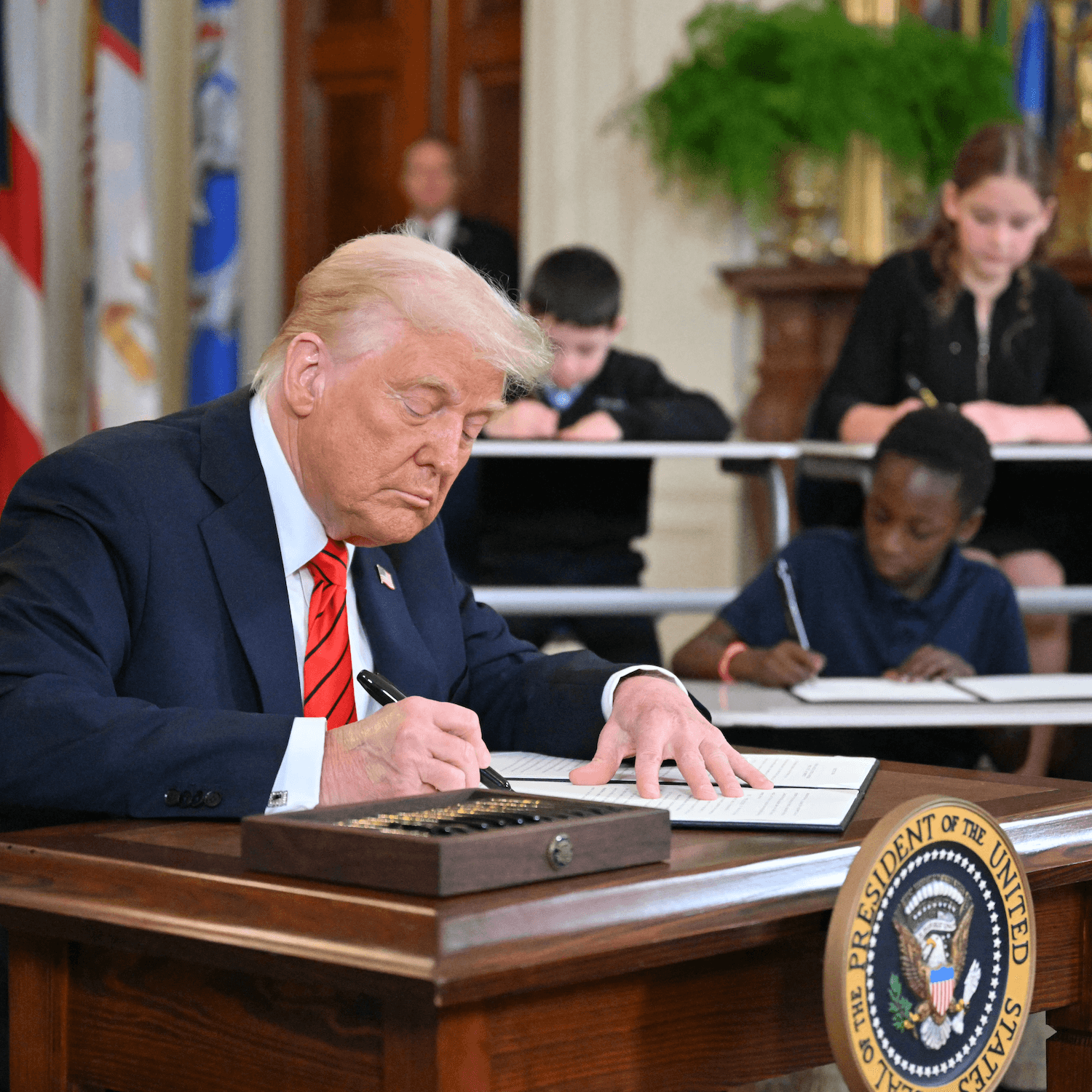
--:-- Shamita Basu: Let's turn now to a promise that President-elect Trump made repeatedly during his campaign, shutting down the Department of Education. I've said all the time, I'm dying to get back to do this. We will ultimately eliminate the federal Department of Education and send education back to Wisconsin and back to the states.
--:-- Shamita Basu: Education has long been the responsibility of state and local governments, which provide 90 percent of the funding for public schools. They set the rules, the policies, the curriculum. So to understand what exactly the Department of Ed does and what it would mean to get rid of it, we called up Washington Post national education reporter Laura Meckler.
--:-- Laura Meckler: The Department of Ed runs what's called the Nation's Report Card, an assessment that helps schools make sure they're staying on track and kids are learning what they should be. It collects statistics on things like crime, staffing and enrollment.
--:-- Laura Meckler: It also oversees the $1.6 trillion student loan program. And it does two other pretty major things. One is it administers a couple of very big grant programs, one of which is called Title I, and it benefits high poverty schools. And the other benefits schools that are serving students with disabilities.
--:-- Laura Meckler: Those programs come with huge budgets. $18.4 billion for the Title I program and $15.5 billion for the program for students with disabilities. And then the other thing that the Education Department does is it enforces civil rights laws. That is Title IX, anything that falls under discrimination based on things like race or sex.
--:-- Laura Meckler: And Trump has promised to roll back legal protections for transgender students implemented by the Biden administration. Conservatives have a problem with that because they don't want, for instance, transgender students to have equal access to bathrooms or locker rooms that match their gender identity.
--:-- Laura Meckler: In a survey of over 100,000 voters recently done by the AP, more than half of people and the vast majority of Trump supporters said they believe support for transgender rights has gone too far in America. The AP also reports crisis hotlines have been flooded by calls from trans kids in the days since the election, with kids saying they're terrified for how their lives could change when Trump takes office.
--:-- Laura Meckler: The reason why it's been somewhat of a lightning rod is because so many of our nation's debates and controversies about what we value and what our culture is going to speak to go through schools. And so the education department ends up being something of a symbol of that.
--:-- Laura Meckler: Meckler says Republicans have argued for years that the department is unnecessary and ineffective. And the bottom line here is eliminating it is a real long shot. Trump would need the support of Congress, and it doesn't look like he'd have enough in the Senate.
--:-- Laura Meckler: Maybe a better way to think about what Trump is proposing here is, is he suggesting eliminating a federal agency and farming out its functions to other departments? Or is he suggesting getting rid of it altogether? The fact is Trump hasn't gone into much detail, though he has suggested he wants to cut education spending in half.
--:-- Laura Meckler: Meanwhile, Project 2025 lays out a plan to assign the DOE's functions to other departments. Another department that is in for big changes under Trump is HHS, the Department of Health and Human Services.
--:-- Laura Meckler: Last week, we talked about RFK Jr.'s record as a longtime vaccine skeptic now that he's been tapped by Trump to lead the department. Well, NPR recently looked at Florida to get a sense of what it could mean to have a vaccine skeptic running health policy.
--:-- Shamita Basu: Florida's Surgeon General is a man named Joseph Latipo. Like RFK Jr., he has a long history of being critical of vaccines. And that position came under more scrutiny earlier this year when there was a measles outbreak in the state.
--:-- Shamita Basu: The CDC recommends in the event of a measles outbreak, parents keep unvaccinated children at home. But here's how Latipo handled the situation, as described by University of Florida pediatrics professor Jeffrey Goldhagen to NPR.
--:-- Jeffrey Goldhagen: He sent a letter to parents basically saying, if you want to keep your kids home, you can keep your kids home. If you want to send them to school, you can send them to school. It violated every, every premise of how measles should be addressed.
--:-- Jeffrey Goldhagen: During the pandemic in 2022, Latipo advised parents against giving their kids the COVID vaccine. A move that the Florida chapter of the American Academy of Pediatrics called irresponsible.
--:-- Jeffrey Goldhagen: And NPR reports last year he received a letter from the CDC and the FDA warning him against spreading misinformation about vaccines.
--:-- Shamita Basu: Lisa Gwynn, a pediatrician in Miami-Dade County, told NPR when she's treating patients, she now has to spend a lot more time trying to counter misinformation. It's probably 50 percent of our job now in pediatrics is explaining to parents the importance of vaccinating their children.
--:-- Shamita Basu: Vaccination rates were already dropping in Florida before Lattipo was appointed to his role. But under his leadership, they dropped even further. Today, the routine childhood vaccination rate for kindergartners in the state is at the lowest it's been in over a decade.
--:-- Shamita Basu: And we're seeing similar trends on the national level. Gwynne told NPR she's worried we'll see that accelerate with a vaccine skeptic like RFK Jr. in charge of national health policy.
--:-- Shamita Basu: I'm very concerned, as are all pediatricians across the nation. One of our primary roles as pediatricians is keeping children safe. And the most effective way to keep children safe from preventable, communicable diseases is vaccines.
--:-- Shamita Basu: Recently RFK Jr has said he will work to make sure parents have the science and information they need to make an informed decision about vaccines for their kids.
--:-- Shamita Basu: Many Republican senators have already come out to say they support Kennedy nomination. But should he not get confirmed NPR says Florida Surgeon General Joseph Latipo is another name that's been floated.
--:-- Shamita Basu: Before we let you go, a few other stories being featured in the Apple News app. On his way to the G20 summit, where climate change will be a top focus, President Biden became the first sitting U.S. president to visit the Amazon.
--:-- Shamita Basu: Folks, we don't have to choose between the environment and the economy. We can do both. We've proven it. Back home. He met with local leaders and indigenous groups working to preserve the rainforest.
--:-- Shamita Basu: He also announced an additional U.S. commitment of $50 million to save the Amazon from deforestation. A goal current Brazilian president Lula da Silva has vowed to accomplish by 2030.
--:-- Shamita Basu: In U.S. election news, there is a recount underway in Pennsylvania in the race between Senator Bob Casey, a Democrat, and Dave McCormick, his Republican challenger, who currently leads by about 20,000 votes.
--:-- Shamita Basu: And there's something of an open revolt taking place against a court order. A few weeks before the election, a judge ruled that mail-in ballots that are missing the date on the outer envelope or have the wrong date cannot be counted.
--:-- Shamita Basu: But Fox News reports that local officials in at least four counties are counting them, saying that the ruling makes no sense. The chairman of the Bucks County Election Commission, who is a Democrat, told the New York Times that it's already known when the ballots were printed, making the outer envelope date a meaningless requirement.
--:-- Shamita Basu: And he said he's prepared to be sued. Meanwhile, in Iowa, Anne Selzer, the revered political pollster who released a surprise poll before the election suggesting Kamala Harris had a three-point edge in that state, announced over the weekend that she is ending her polling operation.
--:-- Shamita Basu: In a column for the Des Moines Register, she said she made the decision a year ago that this election would be her last and suggested the recent election results were humbling for her as a data scientist who believed the data was pointing in the other direction.
--:-- Shamita Basu: And finally, today, when the sun sets in the northernmost town in the United States, residents won't see the sun rise for another 64 days. This is what life is like for the folks in Utkiavik, formerly Barrow, Alaska, where for two months of every year, the sun stays below the horizon, a period of time known as polar night.
--:-- Shamita Basu: It begins with today's sunset at 1.27 p.m. local time. When the sun finally rises again on January 22nd of 2025, it'll peak out for a brief 48 minutes before setting again. The days will grow longer after that.
--:-- Shamita Basu: You can find all these stories and more in the Apple News app. And if you're already listening in the News app right now, we've got a narrated article coming up next.
--:-- Shamita Basu: David Brooks argues in The Atlantic that the meritocracy that exists in our country, sorting the educated from the uneducated and holding Ivy leagues as the gold standard is not working and that we need something new.
--:-- Shamita Basu: If you're listening in the podcast app, follow Apple News Plus Narrated to find that story. And I'll be back with the news tomorrow.