--:-- [Theme music fades out]
--:-- Host: This BBC podcast is supported by ads outside the UK. Listen on BBC.com or wherever you get your podcasts.
--:-- Host: After her predecessor was ousted by violent youth-led protests. Also in this podcast, daily life in a war zone. This must be the most dangerous bread delivery in the world. If it weren't for the fact that we have an armoured car, no one would be bringing bread there anymore. We'll bring you a special report from frontline communities in eastern Ukraine.
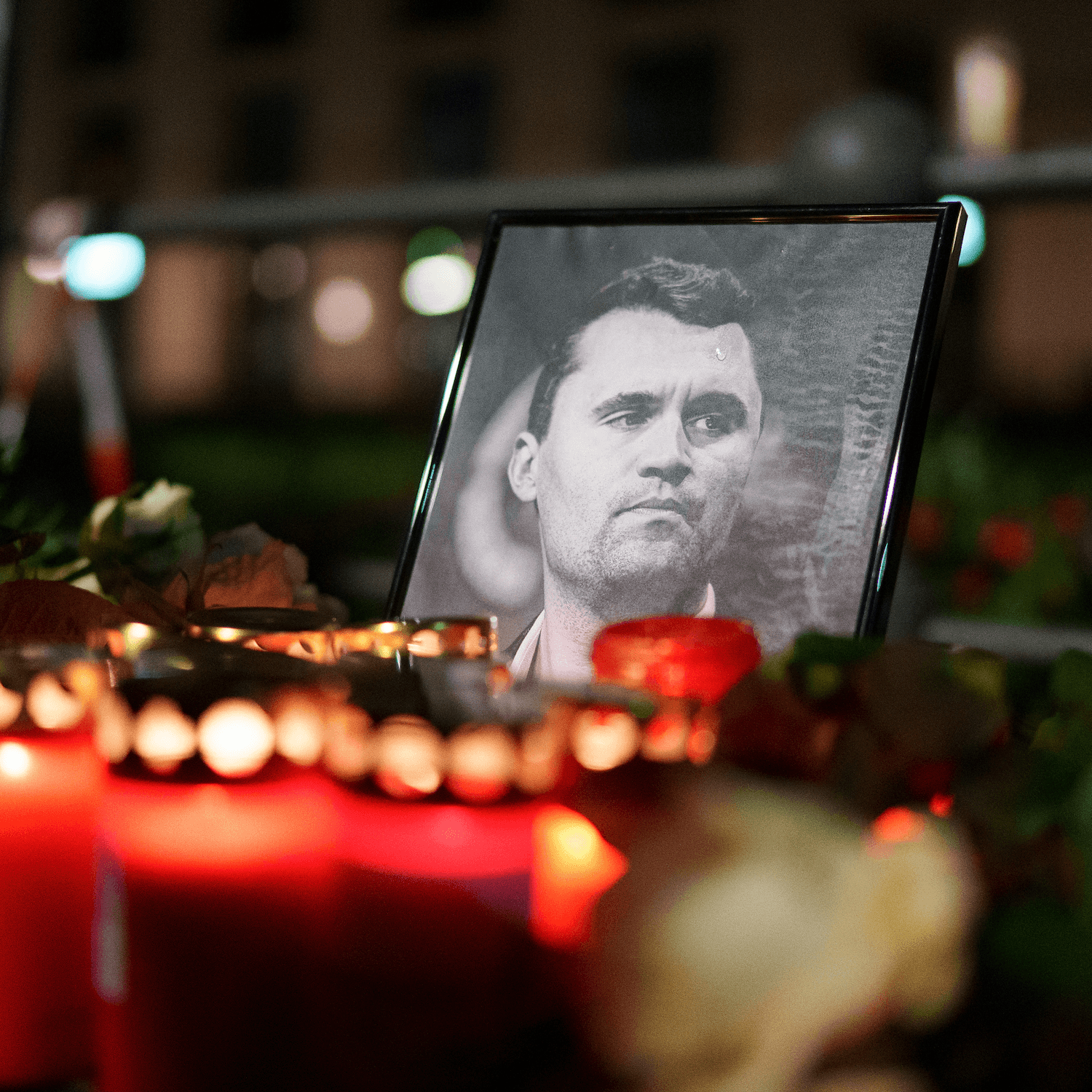
--:-- Host: We got him. That's how the governor of the US state of Utah put it, as he announced the arrest of a man in connection with the murder of the right-wing influencer Charlie Kirk on Wednesday.
--:-- Governor Spencer Cox: The 22-year-old Tyler Robinson from Utah was taken into custody after a tip-off by a family member.
--:-- Host: Mr. Kirk was shot in the neck whilst addressing a large crowd at Utah Valley University. Officers are examining evidence, including bullet casings apparently carved with phrases such as, hey fascist catch.
--:-- Host: Our North America correspondent Neda Taufik sent this report from Utah.
--:-- Neda Taufik: Congratulations, you have been selected to receive the residential scholarship. This was Tyler Robinson years ago, celebrating his scholarship to university. Today, his unsmiling face is on a mugshot.
--:-- Neda Taufik: The 22-year-old was taken into custody late last night from his home in southern Utah, hundreds of miles from where he is accused of fatally shooting Charlie Kirk.
--:-- Neda Taufik: Tyler Robinson's father persuaded his son to turn himself in after he confessed to him that he was the one who shot Mr. Kirk.
--:-- Neda Taufik: News of his arrest was broken by President Donald Trump, who was appearing on a Fox News breakfast show to talk about a baseball game he attended the night before.
--:-- President Donald Trump: With a high degree of certainty, we have him. We're in custody, in custody. Everyone did a great job. We worked with the local police, the governor. Everybody did a great job.
--:-- Neda Taufik: After a manhunt that lasted 33 hours with the FBI appealing to the public for help, the authorities confirmed the suspect's identity and explained what had happened overnight.
--:-- Neda Taufik: They interviewed a family member who told them Robinson had become more political in recent years.
--:-- Neda Taufik: Utah's governor, Spencer Cox, said the family had discussed the conservative activist's upcoming event at Utah Valley University.
--:-- Governor Spencer Cox: In the conversation with another family member, Robinson mentioned Charlie Kirk was coming to UVU. They talked about why they didn't like him and the viewpoints that he had.
--:-- Neda Taufik: The family member also stated Kirk was full of hate and spreading hate.
--:-- Neda Taufik: Police then tracked down his roommate who showed them several social media messages he said Tyler Robinson had been sending.
--:-- Neda Taufik: Here's Governor Cox again.
--:-- Governor Spencer Cox: The content of these messages included messages affiliated with the contact Tyler, stating a need to retrieve a rifle from a drop point, leaving the rifle in a bush, messages related to visually watching the area where a rifle was left, and a message referring to having left the rifle wrapped in a towel.
--:-- Neda Taufik: The messages also refer to engraving bullets and a mention of a scope and the rifle being unique.
--:-- Neda Taufik: The authorities have a significant amount of evidence in this case, including recovering bullet casings engraved with anti-fascist messages.
--:-- Neda Taufik: The governor said he had hoped the gunman wasn't one of their own from Utah. That he was added another layer of shock to the community here in Orem.
--:-- Neda Taufik: That report by Neda Taufik.
--:-- Host: The latest attack comes at a time when the U.S. is highly polarised. The Utah governor has even described it as a watershed moment.
--:-- Robert Pape: I'm Robert Pape, director of the Chicago Project on Security and Threat, which researches terrorism and conflict.
--:-- Host: My colleague Anita McVeigh put it to him that, following the assassination of Charlie Kirk, a lot of public figures in the U.S. will be feeling nervous.
--:-- Anita McVeigh: That's absolutely correct. So Charlie Kirk was an extremely prominent figure in the MAGA movement, but he's not a unique figure in the MAGA movement.
--:-- Robert Pape: And this is true on the left as well, or for Democrats as well. You have elected officials and then you have media influencers who are extremely prominent.
--:-- Robert Pape: So on the Republican side, you have a number of podcasts with millions of views or certainly near that. And this is exactly one of the reasons that Charlie Kirk has been targeting.
--:-- Robert Pape: He's extremely prominent. And then you also have leaders in Congress. You have leaders who are going right now to plan town halls.
--:-- Robert Pape: You have leaders who are planning town halls, trying to figure out, should they have metal detectors? Should they even go?
--:-- Robert Pape: This is going to be the new world we've moved into. And it's not a world that's going to be over in just a day or two.
--:-- Robert Pape: I'm sorry to say we've reached a watershed moment of political violence in the United States.
--:-- Robert Pape: In June, I published a large New York Times op-ed titled We Are on the Brink of Major Political Violence.
--:-- Robert Pape: Your listeners can go see that. This is now happening and this is going to be with us for months.
--:-- Robert Pape: So how would you advise high-profile individuals to deal with this in the days and weeks ahead, given that an essential part of what they do is being seen by the public, is communicating directly to the public, not only speaking from a podcast studio or via a TV camera?
--:-- Robert Pape: Yeah, there is no magic solution to this. This is a problem where they are effectively what we call soft targets.
--:-- Robert Pape: They do not have the money to have the security that a president or a prime minister is going to be is going to have.
--:-- Robert Pape: You're not going to have hundreds of people able to surveil an event in advance. You're not going to be able to.
--:-- Robert Pape: So this is going to be a major challenge. And this is one of the reasons why for years I've been saying we have to do more to tamp down political violence in the United States.
--:-- Robert Pape: This is not just a new thing. My research at the University of Chicago has been going on for five years on the growth of American political violence.
--:-- Robert Pape: And now we reached a watershed moment. There going to be a quick cheap solution to this.
--:-- Robert Pape: The best near-term solution is for political leaders on different sides of the aisle. In America, that means Democrat and Republican to make joint video statements to condemn violence from their own side.
--:-- Robert Pape: So we've got to get out of this idea where Democrats complain about the Republican side of the House and Republicans complain about the Democratic side of the House.
--:-- Robert Pape: Our research shows that only makes it worse. If the leaders will condemn violence from their own constituents, this is how you can actually lower the temperature.
--:-- Robert Pape: We have research that shows this. And now the politicians have real reason because their lives are on the line.
--:-- Robert Pape: So they've got to make a real choice here. And the key thing they can do is they can make joint video statements.
--:-- Robert Pape: I mean, senators from both sides, Republican, Democrat, governors from both sides, Republican, Democrat, former presidents from both sides, Republican, Democrat, joint video statements.
--:-- Robert Pape: And not just a one off, multiple of this because we've reached a fever point.
--:-- Host: To Nepal now, and a new interim leader has just been sworn in, following a wave of protests earlier this week, which forced the prime minister to step down.
--:-- Host: Sushila Khaki will be the country's first female leader.
--:-- Host: The protests were sparked on social media and driven by students and young activists.
--:-- Host: And things only got worse when the previous government blocked all access to social media platforms.
--:-- Host: But the process to select the new interim prime minister took place not by way of political convention or any normal parliamentary method, but through chat rooms on Discord, a platform popular with video gamers.
--:-- Host: This was the view of one young protester.
--:-- Young Protester: We were wanting her for a long time. Generally, this revolution was not just for a day or two. It was like for years and years people were longing for something like this and we are so happy.
--:-- Host: I'm so proud, like literally proud of this moment.
--:-- Host: So what do we know about the new interim Prime Minister, Sushila Khaki?
--:-- Host: Here's our global affairs reporter, Anbarasan Etarajan.
--:-- Anbarasan Etarajan: She was the former Chief Justice of Nepal's Supreme Court, well known for some of her judgments targeting corruption, even at the highest political level.
--:-- Anbarasan Etarajan: That even earned the wrath of the then government in 2016-17 when there was a motion to impeach her.
--:-- Anbarasan Etarajan: and she's highly respected within the country.
--:-- Anbarasan Etarajan: The fact that the youth or Gen Z who were protesting against the previous government chose her as the leader so that she can clean up and she can hold a free and fair election shows what kind of respect she has.
--:-- Anbarasan Etarajan: And there has been widespread welcome and people saying and she's the right person to lead this country at a time of difficulty.
--:-- Anbarasan Etarajan: And Barisan, these protests were driven by social media at the start. That's not anything too unusual.
--:-- Anbarasan Etarajan: But what's so extraordinary about what's happening in Nepal right now is it seems that the process for political change has been happening on Discord, this app for gamers.
--:-- Anbarasan Etarajan: It's quite unprecedented. Probably this is the first time we are seeing in the region where a video gaming chat room was instrumental in choosing the country's interim leader.
--:-- Anbarasan Etarajan: Now, these Gen Z or young people, they were organizing these polls, even on this Discord channel, which is very popular with video gamers.
--:-- Anbarasan Etarajan: It certainly grew up from 40,000 to 140,000 members.
--:-- Anbarasan Etarajan: And the chat rooms were full of discussions about where the country can go, what they can do.
--:-- Anbarasan Etarajan: This momentum built up. And in fact, there was a poll within this Discord channel, how to choose the leader and Sushila Kharki got the maximum number of votes.
--:-- Anbarasan Etarajan: Of course, there are critics who would say that this is not the best way. There are flaws because there can be trolls who can join this discussion on the chat room.
--:-- Anbarasan Etarajan: But even though events in Sri Lanka and Bangladesh where social media was used to mobilize people for protest, here is a process where instead of sitting in a big convention center or in a government hall where you have 100,000 people joining in a chat room, of course, going to be chaotic, but they did come out with something which can be acceptable to everyone.
--:-- Anbarasan Etarajan: And that is where this protest is quite different from other events in the region.
--:-- Anbarasan Etarajan: But at the same time, what's going to happen next, whether the youth-led movement can sustain the structure after what they call as a huge revolution for a country like Nepal.
--:-- Host: And Barisan Etarajan.
--:-- Host: The regime of North Korean leader Kim Jong-un has long been accused of human rights abuses against its own people, subjecting them to religious persecution, starvation, forced labour.
--:-- Host: And now a major new report by the UN has accused Pyongyang of increasingly implementing the death penalty for people watching and sharing foreign films and TV shows.
--:-- Host: The UN is now calling for the situation to be referred to the International Criminal Court in The Hague.
--:-- Host: Our Seoul correspondent Jean McKenzie has the details.
--:-- Jean McKenzie: It's long been known that North Koreans endure some of the worst human rights abuses in the world.
--:-- Jean McKenzie: But according to this report, their suffering is getting worse.
--:-- Jean McKenzie: The UN has interviewed more than 300 people who've escaped the country in the past decade and found that the government has tightened its control on all aspects of people's lives.
--:-- Jean McKenzie: The death penalty is being handed out more often, including to people caught watching and sharing foreign films and TV shows.
--:-- Jean McKenzie: As Kim Jong-un tries to limit his citizens' access to information.
--:-- Jean McKenzie: Witnesses have told the UN that the executions are carried out by firing squads in public to instill fear in people.
--:-- Jean McKenzie: We spoke to a young woman who escaped the country two years ago.
--:-- Young Woman: She said three of her friends were executed after being caught with South Korean content.
--:-- Jean McKenzie: I went to one of my friend's trials where he was sentenced to death. He was tried alongside drug criminals.
--:-- Jean McKenzie: These crimes are treated the same now. It made me very afraid.
--:-- Host: The UN wants the situation to be referred to the ICC, but that referral would need to come from the UN Security Council, and two of its members, Russia and China, are currently supporting North Korea.
--:-- Host: Just last week, all three leaders came together for a military parade in Beijing.
--:-- Jean McKenzie: In 2022, scientists studying images captured by the James Webb Space Telescope noticed previously unseen little red dots.
--:-- Jean McKenzie: Well, ever since, they've been trying to work out what they are.
--:-- Jean McKenzie: Early on, some thought they might be very distant and therefore very old galaxies.
--:-- Jean McKenzie: But now, researchers think they might be something entirely different, a new class of object called black hole stars.
--:-- Jean McKenzie: Rebecca Kesby has been speaking to the lead author of a new study, Dr. Anna de Kraf at the Max Planck Institute for Astronomy in Heidelberg.
--:-- Rebecca Kesby: She began by describing what these little red dots look like.
--:-- Dr. Anna de Kraf: They have these very very red colours and that also why we didn see them before right So with the other telescopes like the Hubble Space Telescope we couldn see them
--:-- Rebecca Kesby: And so we recently took what we call spectra of these little red dots.
--:-- Dr. Anna de Kraf: You essentially split the light kind of like a rainbow. And in doing that, you get a fingerprint.
--:-- Rebecca Kesby: And then you can compare that fingerprint to all sorts of different models.
--:-- Dr. Anna de Kraf: So what we did is we took basically every model we could think of. So stars like in our own Milky Way, different galaxy types, different black hole models, and nothing could fit the data.
--:-- Rebecca Kesby: And so that led us to conclude that we need something totally new.
--:-- Dr. Anna de Kraf: Wow, this is really interesting. So this could be a totally new kind of form then. I mean, so they're not really stars, we don't think.
--:-- Dr. Anna de Kraf: Exactly. So they have some properties that are a little bit like stars. So we think they are essentially glowing balls of gas, but very different from stars.
--:-- Dr. Anna de Kraf: They're not fueled by nuclear fusion in the center, so like our own sun would be. But instead, there is a black hole in the center that is powering this whole star-like object.
--:-- Rebecca Kesby: That's why we call them black hole stars. But it's a very new phenomenon.
--:-- Dr. Anna de Kraf: It sounds very exciting, but it sounds like it's going to be quite difficult to prove or really find out.
--:-- Dr. Anna de Kraf: Well, first of all, we've ruled out that it cannot be anything that we're familiar with. And so we have to kind of go back to the drawing board and come up with something new.
--:-- Dr. Anna de Kraf: And what we're doing now is taking more and more detailed observations still with James Webb to try and tease out what is the actual physics here.
--:-- Dr. Anna de Kraf: So I think we are convinced that there is a lot of gas there, kind of like a star. And we are also, for the most part, convinced that there has to be a black hole in the centre.
--:-- Dr. Anna de Kraf: But the details of this require more work. Like, how do you form such a system? Where does it end up?
--:-- Rebecca Kesby: And so we're now getting the right data to figure out all these important details.
--:-- Host: Still to come?
--:-- Host: That was one of the photos that led Michelle, the bride, to turn detective. Who was this tall man in her wedding pictures?
--:-- Host: A Hunt for a Mystery Wedding Guest. Weekday will bring you a story from this intersection, where the world and America meet.
--:-- Host: Listen on BBC.com or wherever you get your podcasts.
--:-- Host: To eastern Ukraine now, where an estimated 218,000 people need evacuation from Donetsk region, including more than 16,000 children.
--:-- Host: The area, which is crucial to the country's defence, is bearing the brunt of Russia's summer offensive, including daily attacks from drones and missiles.
--:-- Host: Some are unable to leave, others unwilling.
--:-- Host: And despite the growing threat from Russian drones, there are those who would rather take their chances than leave their homes behind.
--:-- Host: From the frontline communities in Donetsk, our international correspondent Quentin Somerville sent this report.
--:-- Quentin Somerville: So they're just loading up the bread dough here. This bread will be given for free to frontline communities To people really who are in a desperate situation
--:-- Quentin Somerville: Two different armoured vehicles arrived at our place from Zvanovka in Sivarsk at 8am They load up and leave
--:-- Quentin Somerville: We bake around 2,500-3,000 loaves of bread a shift and give them away the next day
--:-- Quentin Somerville: This must be the most dangerous bread delivery in the world
--:-- Quentin Somerville: We've moved three times already
--:-- Quentin Somerville: If it weren't for the fact that we have an armoured car no one would be bringing bread there anymore
--:-- Quentin Somerville: We're heading into Bilozerska It's been getting hammered by the Russians
--:-- Quentin Somerville: The biggest threat here is drones most of the vehicles have drone jamming equipment
--:-- Quentin Somerville: Just listen to how quiet it is here in Bilozerska
--:-- Quentin Somerville: We've hardly seen a soul, and there's good reason for that.
--:-- Quentin Somerville: Because Russia has been increasing, not lessening its attacks, since that summit in Alaska.
--:-- Quentin Somerville: The old, the sick, the infirm, those that couldn't already make it out are stuck here.
--:-- Quentin Somerville: The only person I meet on the streets that day is a man pushing a bicycle.
--:-- Quentin Somerville: He's been to the bombed-out house of his sister-in-law to collect a couple of metal pots.
--:-- Quentin Somerville: Volodymyr has his own reasons for staying.
--:-- Quentin Somerville: What will be, will be at 73 years old. I'm not afraid anymore.
--:-- Quentin Somerville: I've already lived my life, so to speak.
--:-- Quentin Somerville: I stayed here because of my wife.
--:-- Quentin Somerville: You know, my wife has had five surgeries.
--:-- Quentin Somerville: Life's challenges don't vanish in war, and 53-year-old Ohla is facing more than most.
--:-- Quentin Somerville: Through acquaintances, we were given this little room for a couple of months.
--:-- Quentin Somerville: And after that, we don't know what to do.
--:-- Quentin Somerville: How is life here now?
--:-- Quentin Somerville: Life is hard. We have no money for food.
--:-- Quentin Somerville: All our savings went to the hospital.
--:-- Quentin Somerville: I have terrible depression.
--:-- Quentin Somerville: I cry at night.
--:-- Quentin Somerville: The closer they come, the heavier the shelling is here.
--:-- Quentin Somerville: We will have to move farther away somewhere.
--:-- Quentin Somerville: But we don't know how because we have no money.
--:-- Quentin Somerville: In Slovyansk, another city under pressure, I listened night after night as the hum of Russian drones changed just before they dive.
--:-- Quentin Somerville: But despite the nightly raids, the 51-year-old Nadia says she's staying.
--:-- Quentin Somerville: You said, Mum, everything will be fine.
--:-- Quentin Somerville: Our son, our son, there are no more tears left to cry.
--:-- Quentin Somerville: We miss you.
--:-- Quentin Somerville: You were our hope for everything.
--:-- Quentin Somerville: On a hilltop above the town, her 29-year-old son Sergei is buried.
--:-- Quentin Somerville: He died fighting the Russians two years ago.
--:-- Quentin Somerville: How can you lose the place where you were born, where you grew up, where your child grew up, where he found his final rest?
--:-- Quentin Somerville: And then to live your whole life with the feeling that you will never again visit this place
--:-- Quentin Somerville: I cannot even imagine that right now
--:-- Quentin Somerville: The longer she stays here the greater the risk to her own life
--:-- Quentin Somerville: But for now, to leave is unthinkable.
--:-- Quentin Somerville: There are no easy goodbyes here in Donetsk.
--:-- Host: Report by Quentin Somerville.
--:-- Host: The southern European nation of Albania has the dubious honour of being rated as one of the continent's most corrupt.
--:-- Host: In our earlier podcast, we reported on what the government of Albania is claiming is a solution.
--:-- Host: It has appointed a new government minister to help fight corruption.
--:-- Host: Her name is Diella and she's a virtual minister powered by artificial intelligence.
--:-- Host: And Diella will oversee government procurement.
--:-- Host: Albania's Prime Minister, Edi Rama, has now given an interview to the BBC.
--:-- Prime Minister Edi Rama: My colleague, Andrew Peach, put it to him that the new minister will just respond to what the humans who program her tell her and will therefore have minimal impact on corruption in the country.
--:-- Andrew Peach: Diela is already helping as a virtual assistant in our very advanced platform where we offer online for all our citizens 95% of our services.
--:-- Andrew Peach: And Diela has helped more than a million applications and has issued herself 36,000 documents with a digital seal.
--:-- Prime Minister Edi Rama: On the other hand, Diela is working for something very fundamental for us, which is the transfer of the acquis communitaire, the European Union body of law, to our legislation.
--:-- Prime Minister Edi Rama: Countries before used armies of translators armies of pre-drafters and drafters and it took a lot of years but you what you've described as a couple of functions that people will be familiar with an AI bot fronting any large organization or government is pretty common really really useful and of course you can use AI for a bureaucratic process of the one you went on to describe
--:-- Prime Minister Edi Rama: But How does it make your government operations 100% free of corruption, which is what you've claimed?
--:-- Prime Minister Edi Rama: This is what we are working. And that's why I explained that this is what we expect from Diela.
--:-- Prime Minister Edi Rama: We are working together with a very, very brilliant team, which is not only Albanian, but also international, to practically come out with the first full AI model in public procurement.
--:-- Prime Minister Edi Rama: Not only will wipe out every kind of potential influence on the process of public biddings, but will also make these processes much more fast, much more efficient, and totally accountable because they will be transparent.
--:-- Andrew Peach: In the end, this is just a big publicity stunt, isn't it?
--:-- Prime Minister Edi Rama: I don't think it hurts.
--:-- Prime Minister Edi Rama: It has also another impact. It forces and it exercises a great hell of pressure on the other members of cabinet, on the other agencies within the country to run and think differently.
--:-- Prime Minister Edi Rama: And this is, in fact, the biggest advantage I'm expecting from this minister that will be there to collect from the others the things that the others should deliver.
--:-- Host: And finally, how many people were at your wedding?
--:-- Host: Did you ever find yourself stumped for a name or not recognising a long-lost cousin or distant relative?
--:-- Host: Well, bride Michelle Wiley was perplexed when she got her wedding photos back in 2021 and had no idea who one of the wedding guests was.
--:-- Host: And after asking the venue, the other guests, the photographer, and of course her husband, she was still in the dark.
--:-- Host: It sparked a four-year manhunt. Now, finally, she has an answer, as Stephanie Prentice reports.
--:-- Stephanie Prentice: It's your friend's big day. Your partner has gone ahead early and you're running late.
--:-- Stephanie Prentice: My partner was actually, he was a bridesman at his friend Michaela's wedding.
--:-- Stephanie Prentice: He went off first thing in the morning.
--:-- Stephanie Prentice: I'm rushing to the venue.
--:-- Stephanie Prentice: I get there. I'd never met Michaela's husband, so I see this groom standing there, nervously waiting.
--:-- Stephanie Prentice: So I'm thinking, cool, right, no worries.
--:-- Stephanie Prentice: Look about and there's one seat left.
--:-- Stephanie Prentice: I'm thinking, that's obviously my seat. I'll take that.
--:-- Stephanie Prentice: It was not, in fact, his seat.
--:-- Stephanie Prentice: Andrew Hillhouse was meant to be at a different wedding two miles away, something that soon became clear.
--:-- Stephanie Prentice: The music starts. Everyone stands up. Everyone turns round in unison.
--:-- Stephanie Prentice: And out comes Michelle.
--:-- Stephanie Prentice: I've just got to roll with it at that point because you can't exactly just get up and walk out of a wedding.
--:-- Stephanie Prentice: So eventually the ceremony ends.
--:-- Stephanie Prentice: Right as I lift myself out the seat, I hear somebody, can we get everybody together for some group photos, please?
--:-- Stephanie Prentice: And I'm just like...
--:-- Stephanie Prentice: That was one of the photos that led Michelle, the bride, to turn detective, who was this tall man in her wedding pictures.
--:-- Stephanie Prentice: Walking down the aisle, didn't even notice them.
--:-- Stephanie Prentice: It was just when I got the pictures back for the photographer I was like, John, who's this guy here right behind my mum and dad?
--:-- Stephanie Prentice: And he's like, I have not got a clue.
--:-- Stephanie Prentice: After the service, the mystery guest was gone.
--:-- Stephanie Prentice: Michelle said the photos would pop into her head over the years and she even wondered if she had a stalker until she decided to ask an influencer to post them.
--:-- Stephanie Prentice: Within two hours of it, we managed to find them.
--:-- Stephanie Prentice: We commented on the post, which is just brilliant.
--:-- Stephanie Prentice: I see all these pictures of me circled and who is this man?
--:-- Stephanie Prentice: And initially I was afraid, I thought I was in trouble.
--:-- Stephanie Prentice: It's such a relief finding out now I don't have a stalker and my husband doesn't have a stalker.
--:-- Stephanie Prentice: Michelle and Andrew have now met, formally, and say they plan to stay in touch, perhaps attending each other's major life events in future, though next time on purpose.
--:-- Host: And that's all from us for now, but there will be a new edition of the Global News Podcast later.
--:-- Host: If you want to comment on this podcast or any of the topics covered in it, you can send us an email.
--:-- Host: The address is globalpodcast at bbc.co.uk.
--:-- Host: You can also find us on X at BBC World Service.
--:-- Host: Use the hashtag Global News Pod.
--:-- Host: This edition was mixed by Holly Smith and the producers were Alison Davis and Stephen Jensen.
--:-- Host: The editor is Karen Martin.
--:-- Host: I'm Julia McFarlane.
--:-- Host: Until next time, goodbye.
--:-- Asma Khalid: America is changing. And so is the world.
--:-- Asma Khalid: But what's happening in America isn't just a cause of global upheaval.
--:-- Asma Khalid: It's also a symptom of disruption that's happening everywhere.
--:-- Asma Khalid: I'm Asma Khalid in Washington, D.C.
--:-- Tristan Redman: I'm Tristan Redman in London.
--:-- Asma Khalid: And this is The Global Story.
--:-- Asma Khalid: Every weekday, we'll bring you a story from this intersection, where the world and America meet.
--:-- Asma Khalid: Listen on BBC.com or wherever you get your podcasts.