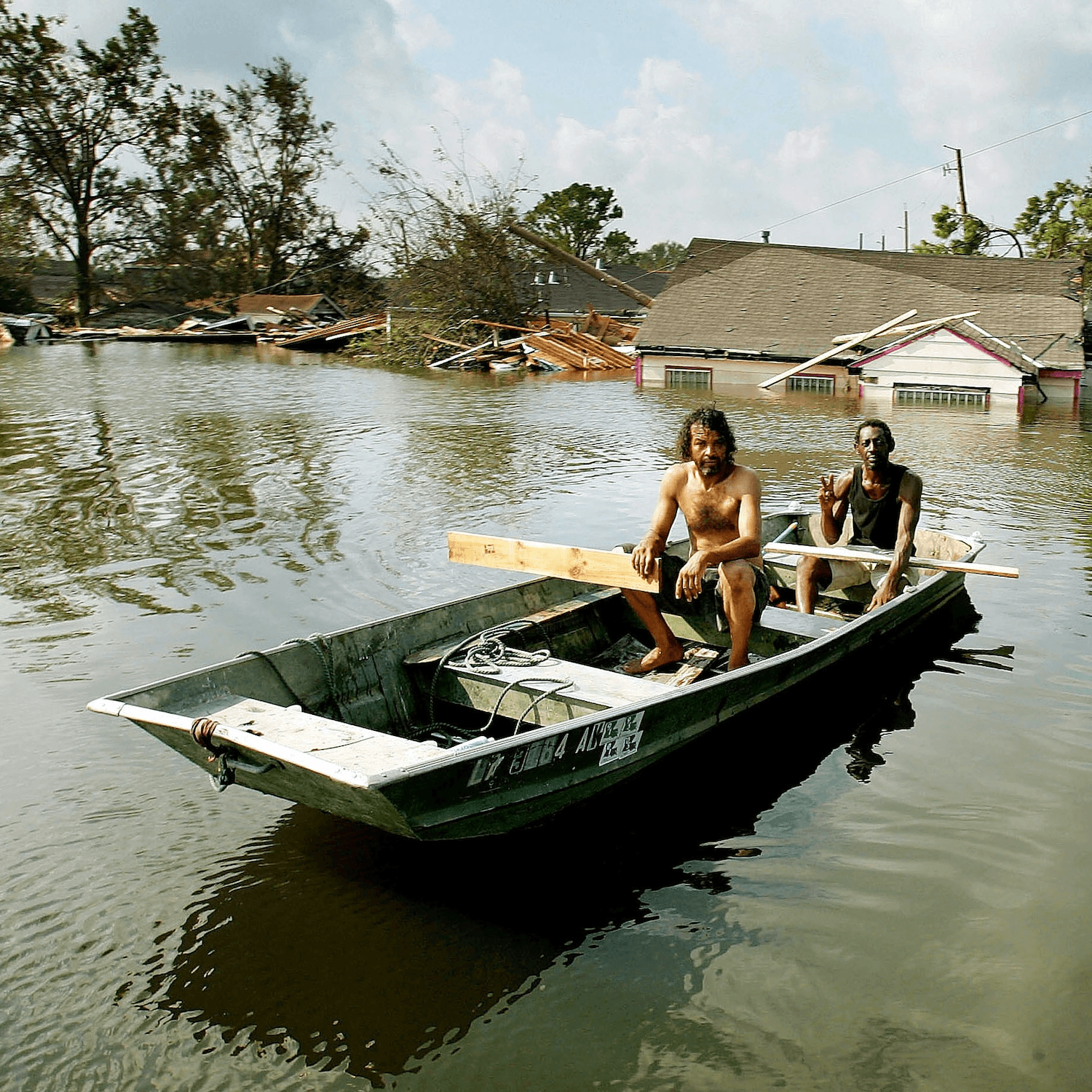
Hurricane forecasting improved after Katrina. That could change.Apple News Today · Aug 29, 2025
Main Topic: The podcast episode is a collection of various stories and interviews that highlight the power of human connection, community, and cooperation.
Key Points:
Participants:
Takeaways:
We meet the woman sending hugs from Texas in the form of a quilt. Connie Kortz set up a network of volunteer quilters, who make them for people who are in need. Called 'Hugs from Texas' -- the group donated quilted blankets to the families affected by the devastating floods earlier this year.
Also, find out about the traditional ceremony that takes place for the first time a baby laughs. We go to the football match between Dulwich Hamlet FC and Altonaer which is celebrating 100 years of friendship.
The Happy Pod is our weekly collection of inspiring, uplifting and happy news from around the world.
Nick Miles
This BBC podcast is supported by ads outside the UK. Go on, get a little out there into the big heart of Nevada, where you can go off-road and off the map on two lakes or on horseback. Dip into hot springs and dive into deserts. Climb a mountain or make your best effort. See thousands of stars in some of the darkest skies. Stake out haunted hotels. Can you make it to sunrise? There's always something new to see because we've got plenty of space to just be. Plan your trip at travelnevada.com.
This is the Happy Pod from the BBC World Service. I'm Nick Miles, and in this edition, you know we told them these these quilt blocks and these things came from all over basically the world now. So this is the whole world reaching out to tell you how much we love you.
The woman sending hugs to people in need through a quilt. In our culture, that first laugh is believed to be the moment that the baby chooses to join the human world. The laugh that they let out is a little announcement, like, I'm here, I want to stay. A traditional ceremony that celebrates a baby's first laugh, plus the football fans coming together after 100 years of friendship.
Harry Bly
Honestly, there was one or two occasions today where I just had goosebumps. It's the beauty and the uniqueness of both clubs. I mean, look, we're an hour after kick-off now and they're still going.
You know, especially for a lot of people when they first come into recovery and out of homelessness, they've lived in a very selfish way. And part of the healing, I think, is to re-find themselves with other people and to realise that there are people there for them too.
The farm giving people a second chance at life. We start in Texas with one woman on a mission to spread love through quilted blankets. Connie Courts runs a craft shop in Victoria and through that has set up a network of volunteer quilters from around the world. Called Hugs from Texas, the group has donated hundreds of quilts to families in need after they've suffered loss and devastation, often through natural disasters.
Connie Courts
I love doing these type of drives to help people when disasters have hit and be it, just a home fire, be it domestic violence, just whatever the situation should be. And these floods were pretty horrific. The Kerr County floods in Texas, 135 people died.
Connie, what was your reaction when you realized the severity of the situation there? The ladies were coming in to sneak away to come sew a little bit in the store and not let anybody know they were there, and I came in and I told Penny, I said, Penny, we need to do a drive to collect quilts.
So we set a goal of 100 quilts. And oh my gosh, we're probably at 750 quilts. We have three machines in our store, long arm machines, that we can quilt, but I don't have the manpower to make this all happen. So that's when we started asking them for volunteers. And boy, did they show up.
It's just been amazing. And these quilts have been going to survivors of the floods and those who've had their homes destroyed or damaged. Yes, and they're also going to people who have lost a loved one.
We had a lady come with her friend, and her son had died saving his wife in the flood. He had two moms. We gave both moms a quilt. We gave a quilt to the wife, and we gave one to the two children. So they have lost the ultimate loss of this.
So we are reaching out to those people to wrap those in hugs too because, you know, we told them these quilt blocks and these things came from all over basically the world now. So this is the whole world reaching out to tell you how much we love you.
What is it about a quilt, Connie, that is so special? You've described it as a hug.
Yes, because, OK, if you buy a blanket, it's just a blanket. You don't know any other history or anything like it. But when you look at a quilt and you see the intricate pattern, you you can't know what it's like to hug someone that you've given that to and when they wrap their arms around you it's like you're then you're one you know you have passed on your your love of something and and then you give it to them and it's a treasured object to them then that's what a quilt means to me.
Connie, you've given your life to sewing and making quilts. Tell me what is it about making these beautiful items that makes you happy?
Both my parents died in 2009 and I had never sewn from 2009 until 2019. I sat on the couch depressed and a friend of mine, my aunt and a friend of mine said, you know what, why don't you think about sewing? You need to make a quilt for your granddaughter. You know, I had a granddaughter and so I did and sewing literally saved my life. It did. I'm not kidding because if I would have sat on that couch another year I may have not made it so when I saw that what I could make you know in my own home I was still sheltered from the outside world you know and in the first year I sewed 30 quilts and my husband would go to work he worked sometimes at night he would leave at 4:30 and he would get home at 6:30 in the morning and he would go have you slept uh-huh he goes no you haven't you have a whole nother quilt top right there. And I'm like, I thought I slept. I couldn't stop.
So sewing has been a lifesaver for me.
Nick Miles
If you're a parent, you will know that there are certain moments in your child's life that will stay with you forever. For the Navajo and Indigenous people in the United States, one of those moments, the first time a baby laughs, is celebrated with family and friends at a traditional ceremony, as Peter Goffin reports.
Peter Goffin
The life of a baby is full of milestones. First cuddle, first time rolling over, first crawl. The life of a new parent is spent commemorating those milestones, with a photo or a video or a note in a journal. For the Navajo people, whose traditional lands are in the southwestern US, One of those firsts, the first laugh, holds extra special meaning and is caused for an extra special celebration.
So in our culture, that first laugh is believed to be the moment that the baby chooses to join the human world. When they're born, it's believed that they're both still in the spirit world and in the human world. The laugh that they let out is a little announcement like I here I want to stay.
Tiffany Black
I was making sugar cookies. My partner was holding our daughter Tinley, and she was watching me as I was mixing the dough. At first, she let out like a tiny little giggle. I couldn't really like tell if it was a laugh. So then I kept mixing the dough more and she let out another laugh. It was even more beautiful that it happened while we were doing something together as a family and just being present with her.
So that laugh kind of was just saying to us, I feel happy, I feel safe, and I want to be here.
Peter Goffin
In Navajo culture, that first laugh is marked with a ceremony and party for family and friends arranged by the person who made the baby laugh. Guests are given food and gifts from the baby. One of the main gifts is salt. In Navajo culture, salt is sacred and symbolizes purity and preservation.
Tiffany Black
The baby gives out the food to everyone. So we'll grab a rock salt and we'll put it in her hand. And the guests will take the rock salt from her and they'll eat the rock salt first before they eat their meal.
I'm not just raising a daughter. I'm raising a future matriarch, a future leader, a future storyteller. I am deeply rooted in my culture and how important it is to carry those teachings forward. So when the baby gives back during her first laugh ceremony, it's more than just a gesture. It's their first step in participating in that idea of Keh.
Keh is the heart of Navajo life. So it's our system of kinship. So how we relate to one another through family, clans, and respect. Keh teaches us that we are all connected. Even strangers can become family when we recognize each other through our clans or relationships.
Peter Goffin
In the end, it's many firsts all rolled into one. A first laugh, a first act of generosity, a first celebration of culture and heritage.
Nick Miles
In 1925, a small football club from London travelled to Hamburg in Germany to play another local team there. A hundred years later, they have just met again in the same spot to play each other again. And in that time, the clubs and supporters have become very good friends.
George Walker
We met behind the far goal. That's Jan Stover, talking about the time he met his friend, Michi Moraf.
Jan Stover
I offered him a fan thing. He said he couldn't speak German and said there are two English articles in it.
Jan is a supporter of Altona, a football club in a former fishing town that's now a western district of Hamburg. Michy's team was Dulwich Hamlet in South London, and it was after the pair got talking at an Altona game that they realised their clubs had a connection.
Both clubs were founded in 1893. He knew that they had quite a history, so he emailed me later and he said, oh, I found out we played each other on Good Friday in 1925, and we won 4-0. And so I looked it up in our book, and it was just one sentence too, and it said, we lost 4-1. I said, no, we scored one.
Mark Dacey
Honestly, there was one or two occasions today where I just had goosebumps. It's the beauty and the uniqueness of both clubs. I mean, look, we're an hour after kick-off now and they're still going.
Ben Clasper
These are two clubs that have been friends for, as you know, 100 years. And in the recent decades it's intensified. And now I always think that when we come here or they come to us, it's just like this oasis where everyone gets together.
Jan Stover
Maybe because we meet like-minded people and we do things differently, but we like the way the other side is doing it and like to join in. And I think in a way we influence each other too.
George Walker
Coming up in this podcast. It turns out in nature as in human societies is that the best way to compete is a lot of times to cooperate with someone who can offer you something.
Nick Miles
The unlikely duo showing scientists that animals can and do work together. Go on, get a little out there, into the big heart of Nevada, where you can go off-road and off the map, on two lakes or on horseback. Dip into hot springs and dive into deserts. Climb a mountain or make your best effort. See thousands of stars in some of the darkest skies. Stake out haunted hotels. Can you make it to sunrise? There's always something new to see because we've got plenty of space to just be. Plan your trip at TravelMevada.com.
Cindy Crawford
Hi, I'm Cindy Crawford and I'm the founder of Meaningful Beauty. When Dr. Sabah and I decided to do a skincare line together, He said to me, we are going to give women meaningful beauty. And I said, that's exactly right. We want to give women meaningful beauty, which means each and every product is meaningful. It has a reason to exist. It's efficacious. You're going to get results. And then you just go out and live your life. Meaningful beauty. Confidence is beautiful. Learn more at MeaningfulBeauty.com.
Nick Miles
According to a nationwide survey conducted by GeneSight, nearly 9 in 10 Americans who've been diagnosed with depression or anxiety believe that mental health medications are somewhat or very effective. However, despite that belief, more than half of those individuals say they have avoided taking medication due to concerns about potential side effects.
Dr. Whitney Brown
That's why Dr. Whitney Brown, a family and psychiatric mental health nurse practitioner based in Alabama, often recommends genetic testing to our patients as part of their treatment journey.
As part of my treatment plan, I offer the GeneSight test, which analyzes how a patient's genes may influence how they metabolize or respond to certain mental health medications. It gives me insights and takes out some of the guesswork that can be associated with prescribing them.
If you or someone you love is facing challenges with depression or anxiety, talk to your doctor about how genetic testing may help. To learn more, visit GeneSight.com.
Nick Miles
That's GeneSight.com.
This message comes from Greenlight. Ready to start talking to your kids about financial literacy? Meet Greenlight, the debit card and money app that teaches kids and teens how to earn, save, spend wisely, and invest with your guardrails in place.
Dave Harvey
Across the world, people go farming for an obvious simple reason, to grow food. But on one British farm, they found another purpose, to help homeless people get their lives back together.
A family farm in Somerset in the southwest of England has converted an old dairy house into a hostel for people recovering from addiction to drugs and alcohol and who have been sleeping rough in the countryside.
We just work our way up, anything from this sort of size. You can pass them through to me and I can pop them in the truck. It's pretty hot in the polytunnel at this time of year, but that's why the tomatoes and the cucumbers are growing fat.
And Dan just loves working here. I love it. I love nature. So, yeah, it's for me, to say the least. But it is literally like a family, so yes, everyone's just lovely, the staff, the volunteers.
Dan is new to kitchen gardening, but feels right at home, which is a new thing for him, after a few years sleeping rough, sofa surfing and chasing casual jobs.
Today he's one of seven residents in the Converted Dairy House, now a hostel for rural rough sleepers.
Lily O'Dowd
No matter how they come to the session, whatever feelings they're bringing, they always leave with a smile or they're feeling like something's been released or let go of.
There's generally always something that has brought them some joy in the session that they do at Roots.
Dave Harvey
Inside, they're cooking up a community lunch. Courgettes and the onions are going to end up with some quinoa into a hot salad and this is a tomato tart and I'm just making some courgette and chip-pea critters.
And everything from the garden? Everything from the garden, yeah.
Kate Dixon
Getting the meeting together, cooking together taking responsibility for each other especially for a lot of people when they first come into recovery and out of homelessness they've lived in a very selfish way and part of the healing I think is to re-find themselves with other people and to realise there are people there for them too.
Dave Harvey
This project is very professionally run. Kate is part of a team of expert social workers managed in partnership with a homeless charity and Somerset Council.
Rob Atticott
Farms are farms, they're mechanised places where we grow things, but they're also incredibly therapeutic.
We have had tremendous successes where people have gone on to own their own house or to sustain a tenancy in a house and find some kind of meaningful work. Farming can be therapy. Now there's a thought.
Dave Harvey
For decades, we've been hearing about how technology and the internet is harming our mental health. But some neuroscientists in the United States have recently made an interesting discovery.
Helena Burke
Their analysis of 57 studies from across the world found that technology use actually helps stave off dementia and cognitive decline in older adults.
Dr. Michael Scullin
Our study analysis involved over 400,000 adults. Their average age was 68 years old. And we were examining whether everyday uses of digital technology was related to cognitive functioning. And what we found was that use of everyday digital technologies amongst this older adult population was associated with a reduced risk for cognitive impairment and slower rates of cognitive decline across time.
This kind of flips the script, doesn't it, on a lot of the traditional understanding that the Internet and a lot of technology use can be quite bad for your brain.
Indeed, there has for years now been some rather alarmist reactions to digital technologies that they could be causing brain rot.
And while, again, there's no simple answer to whether they're always good or whether they're always bad, at least amongst the generation that we were studying, these were all adults, middle-aged and older adults when the digital technology revolution began.
So they weren't learning about technology as kids. They were having to change how they operated at work and at home and in social life. And amongst this digital pioneer generation, the net outcome seems to be positive.
And what do you think some of the mechanisms are for technology use preserving brain function in older people?
The first we call cognitive complexity. The idea here is that as you're having to learn to use a home computer, use a smartphone, this can actually be experienced as quite difficult.
We've probably seen this in family members that they got a new phone, new device, and they can struggle with it. And while that struggle is certainly frustrating at the time it's happening, it's also representative of the brain is being challenged.
And researchers have known for quite some time that mental stimulation can be a good thing. And so theoretically, having these internet-based devices that enable email, that enable texting with family members, that these could be socially connecting.
You can always have too much of a good thing. And I think if you spending 12 hours a day doing any one thing you should probably take a critical eye of am I using all of those hours the right way.
My recommendation is that if there is a family member or friend who has not learned how to use a smartphone or a tablet or something similar to that to encourage them to do something. But maybe don't be the person to train them on it.
So if you have in your city technology classes for older adults, those exist in a number of cities. That's one option. Maybe get a friend or someone else where there could be potentially less tension or impatience.
Even with our best intentions, sometimes we're not as patient with our own family members as someone else would be.
Lucy Atchison
A cow owned by farms in both Northern Ireland and the Republic of Ireland has won a prestigious dairy contest. The six-year-old Holstein Frisian is the first cross-border cow in the 50-year history of the Irish champion dairy cow competition, helping bridge divides.
Anna Moore Fitzatley, X96, known as the Fitz, has made history as the first cross-border cow in the pedigree dairy world. She's jointly owned by families in County Armagh and County Wexford and was raised on both sides of the Irish border as part of a shared ownership agreement.
Her title comes from her exceptional dairy score, X96 out of 100, which is one of the highest ratings a cow can achieve and recognises excellence in milk quality and physical traits.
The Fitz was first graded at 95 while she lived in Porter Down, but after being transferred to the Republic earlier this year, her score was revised upwards.
Josh Ebron
I think what is really important within our industry that we can work together with the same mindset and the same visions and the same goals. We can go further, faster.
Lucy Atchison
She has all the dairy characteristics that would be desirable to a dairy farmer. She produces a lot of milk of good quality and she's a cow with amazing dairy strength.
Not only is the Fitz regarded as a fine example of cross-border cooperation, but she's also now recognised as one of the very best dairy cows in the world.
Terry Egan
In Disney's film The Lion King, we follow the unlikely pairing of a meerkat, Timon and a warthog, Puba. They happily pass their time away like two old friends at a bar, relying on their Swahili motto, Hakuna Matata, or no worries.
Now, researchers in Peru seem to have come across an equally unlikely pairing.
The growl of an ocelot. With an ocelot looking something like an oversized cat and an opossum looking nothing if not like a big mouse, you might think these mammals were the perfect example of predator and prey.
That's why a video taken in Peru while researchers were studying birds in the Amazon was such a surprise.
We thought it was super crazy. And then we saw two minutes later they came back together. This was really exciting for us. We've never seen something like this.
There, looping along close to one another, was an ocelot and an opossum. And at first, of course, the researchers at the Cocha Cashew Biological Station suspected the ocelot might be doing some researching of its own, tracking its quarry.
But if that were the case, the opossum was hardly acting in the way you might expect a hunted animal to act.
Isabel Dimash Moreira
They look like just two friends walking around and it was really striking us that this is more than a predator-prey event.
Other researchers, too, pointed to a slightly different interpretation. They highlighted videos that had been taken elsewhere in the Amazon rainforest, revealing other ocelot-opossum pairings. Up to four, in fact.
Ettore Kamalenghi
So could this be something else? And if so, how to proceed? Well, a colleague had already done some research involving pieces of cloth permeated with the scent of an ocelot.
He did an experiment, was looking for something completely different, but by chance he also put some ocelot sands. And he observed that many opossums were coming and kind of rubbing their fur and spending time in the presence of the ocelot sands. So there was an attraction. Very curious.
Errol Achai
What was more difficult to figure out, though, was why all this was happening. But there are suggestions.
There might be some sort of odor masking. The opossums evidently are notoriously smelly. And maybe the ocelots are using the smell of the opossums to mask their own smell while they hunt.
Possibly the opossums might be better at finding some prey that the ocelots are not good at finding. And then they can share it.
If that's the case, it would mirror the relationship between coyotes and badgers in North America, where the two sometimes go hunting together.
Working in tandem, they often manage to catch squirrels or prairie dogs.
In fact, this could be a good example of the unexpected and underreported cooperation in nature in general.
It tells us that cooperation in nature is much more widespread than people tend to assume. Because, you know, natural selection is a process that's based on competition and everybody's competing to get access to resources and mates and so on.
But it turns out in nature, as in human societies, that the best way to compete is a lot of times to cooperate with someone who can offer you something.
Terry Egan
For all the clues then, no conclusive proof. But in the absence of that, it's just possible to imagine the ocelots and the opossums like their Disney counterparts who plan to live with no worries for the rest of their days, just enjoying hanging out together.
Nick Miles
And that's all from The Happy Pod for now. We'd love to hear from you. As ever, the address is globalpodcast at bbc.co.uk. And you can now watch some of our interviews on YouTube. Just search for The Happy Pod.
This edition was mixed by Derek Clark and the producer was Holly Gibbs. The editor is Karen Martin. I'm Nick Miles and until next time, goodbye.
Susan Glasser
Hi, I'm Susan Glasser. I'm Jane Mayer. And I'm Evan Osmos. And we host the Washington Roundtable from the New Yorker's Political Scene podcast.
For me, this is the water cooler. This is a wonderful chance to sit down with two of the smartest colleagues in the country and, you know, just kind of compare notes.
Jane Mayer
No, that's so true, because first of all, we are actually friends in real life, but I can't wait till Fridays to hear what you guys think.
Evan Osmos
Everybody sees the headlines, but you guys fill in the gaps.
Susan Glasser
I also think, though, occasionally we get somebody to come on, and I'm always smarter for it. If you get a great historian who can tell you about a presidential election 50, 60 years ago, often it can help you understand about what's happening today.
Jane Mayer
So if you're looking for weekly insights into what's going on inside the Beltway, please join us every Friday on the Washington Roundtable, part of the New Yorker's political scene podcast.

