--:-- Tracy Mumford: From the New York Times, it's the headlines. I'm Tracy Mumford. Today's Tuesday, September 23rd. Here's what we're covering.
--:-- Tracy Mumford: I think I can say that there are certain groups of people that don't take vaccines and don't take any pills that have no autism. That have no autism. Does that tell you something? That's currently. Is that a correct statement, by the way?
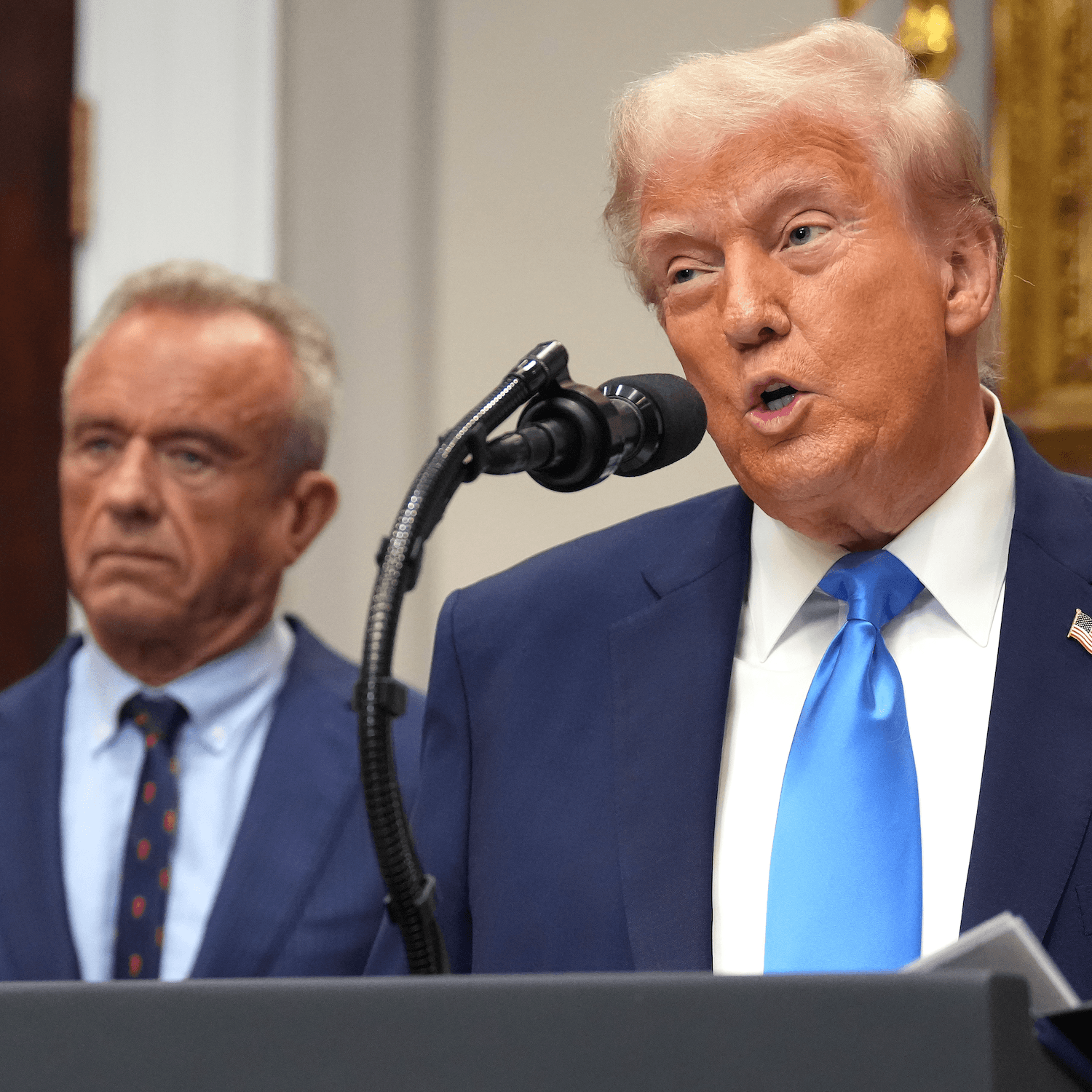
--:-- Emily Baumgartner-Nunn: At the White House yesterday, President Trump joined top federal officials for a press conference about the root causes of autism, the neurological disorder whose symptoms can range widely, from struggling to read social cues to being unable to speak.
--:-- Tracy Mumford: The meteoric rise in autism is among the most alarming public health developments in history. There's never been anything like this. Autism diagnoses in children have been rising. Public health experts say a big part of that is increased awareness. More people are talking about it with their kids' doctors.
--:-- Emily Baumgartner-Nunn: There have also been decades of research into potential risk factors, including everything from air pollution to the age of people's parents, as scientists overwhelmingly agree that autism results from a complex mix of environmental factors and genetics.
--:-- Tracy Mumford: Taking Tylenol is not good. I'll say it. It's not good. President Trump claimed, though, without new evidence, that it could be caused by acetaminophen, the active ingredient in Tylenol. It's something scientists have looked at for years.
--:-- Emily Baumgartner-Nunn: Studies have so far yielded inconclusive results. A scientific review this summer found there was evidence of a link between acetaminophen use during pregnancy and neurodevelopment disorders like autism and ADHD, but not a definitive cause-and-effect relationship.
--:-- Tracy Mumford: It is. Don't take Tylenol. Don't take it if you just can't. I mean, it's a fight like hell not to take it. My colleague Emily Baumgartner-Nunn covers health at The Times. She says that the president's repeated warnings about Tylenol flew in the face of recommendations from leading medical groups, which say that limited acetaminophen is safe during pregnancy.
--:-- Emily Baumgartner-Nunn: So far, all of the scientific experts we've spoken to since that press conference have stood by their previous opinion, which is that Tylenol or acetaminophen should only be used in pregnancy in low doses at the least frequent interval possible but that sometimes Tylenol is necessary because fevers during pregnancy can really bring about all of their own risks.
--:-- Tracy Mumford: At the press conference, Health Secretary Robert F. Kennedy Jr. and the Commissioner of the FDA announced there will be more research into autism, with millions in federal funding going to study other environmental factors, including a long-debunked theory that blames vaccines.
--:-- Tracy Mumford: At the Supreme Court, the conservative majority has said that President Trump can fire one of the heads of the Federal Trade Commission, setting up a court battle over the limits of presidential power.
--:-- Elena Kagan: When Trump moved to fire the Democratic member of the FTC earlier this year, her lawyers fought back, pointing to a ruling from the Supreme Court in 1935 over a nearly identical scenario when President Franklin D. Roosevelt tried to fire an FTC commissioner.
--:-- Tracy Mumford: In that case, the court ruled that presidents cannot remove independent regulators just because they disagree over policy. Now, by issuing their emergency order letting her be fired, the court is suggesting it's open to overturning that landmark precedent.
--:-- Elena Kagan: It will hear full arguments in the case in December. The liberal justices, meanwhile, issued a sharp dissent, with me writing that it opened the door to presidents firing regulators, quote, for any reason or no reason at all, and that my colleagues were essentially letting the president take control over agencies that were supposed to be protected from partisan politics.
--:-- Tracy Mumford: Kagan also made a broader critique of the way that the court was making its decision, through its emergency docket, which is also known as the shadow docket. That fast-track process where the justices can issue unsigned and unexplained rulings without having heard oral arguments has been criticized for years, but it's come under increasing scrutiny as the Trump administration has brought more than 20 emergency applications to the court this year alone.
--:-- Tracy Mumford: Tonight Jimmy Kimmel will be back on the air. In the last week the late host has been at the center of a political firestorm and a fierce debate over free speech in the US.
--:-- Jimmy Kimmel: [statement] In a statement, Disney, which owns ABC, said it had stopped production, quote, to avoid further inflaming a tense situation at an emotional moment for our country.
--:-- Tracy Mumford: Kimmel had been planning an opening monologue about the whole controversy that made executives nervous. The Times has learned that after the show was pulled, leaders from Disney sat down with Kimmel and his lawyer to figure out a path to getting the show back on air.
--:-- Jimmy Kimmel: [statement] In a statement, Disney, which owns ABC, said it had stopped production, quote, to avoid further inflaming a tense situation at an emotional moment for our country.
--:-- Tracy Mumford: In that first meeting, Kimmel did not agree to change his script. A decision about what Kimmel will say tonight was made yesterday after more discussion.
--:-- Tracy Mumford: Though he'll be returning to ABC, it's not yet clear exactly how widely the show will be broadcast. At least one of the TV companies that publicly criticized Kimmel, the conservative media giant Sinclair, has said it won't be airing the show.
--:-- Tracy Mumford: Sinclair owns about two dozen ABC affiliates and had previously called on Kimmel to apologize to Kirk's family and make a donation to his political group, Turning Point USA.
--:-- Tracy Mumford: This morning, the Secret Service announced that it uncovered and dismantled a cache of devices in the New York region capable of crashing the cellular network.
--:-- Secret Service Agent: The agency said it found more than 100,000 SIM cards and 300 servers set up in a sophisticated configuration. They were stashed in several locations, all within a 35-mile radius of the United Nations headquarters in Manhattan.
--:-- Tracy Mumford: This week is the annual General Assembly at the UN, which draws more than 100 foreign leaders and their staff. Given the sensitivity of the gathering, where allies can be sitting right next to enemies, it's been described as the Super Bowl of spy games.
--:-- Secret Service Agent: The Secret Service, which oversees security for the event, says it made the discovery last month. Officials at the agency told the Times there no evidence that the network the largest they ever seen posed a direct threat to the conference.
--:-- Tracy Mumford: But the illicit system could have interfered with emergency response services jammed communications or even been used for eavesdropping.
--:-- Secret Service Agent: One cybersecurity researcher said that only a handful of countries could pull off this kind of operation, including Russia, China, and Israel.
--:-- Tracy Mumford: The top agent at the Secret Service's New York field office said the investigation is ongoing, but, quote, there's absolutely no reason to believe we won't find more of these devices in other cities.
--:-- Tracy Mumford: And finally. So I had just finished flight training for the day and my spouse and I were on the couch. We get a call from an unknown number and we both look at each other and then we're like throwing blankets and pillows. Oh my gosh, where's the remote? Turn the TV off.
--:-- Aaron Overcash: Yesterday, I took the stage at a press conference in Houston to describe getting the call, the call that she would be one of NASA's new class of astronauts.
--:-- Tracy Mumford: He effectively said, do you still want the job? And the first words that I said on the phone were, no way. I mean, I mean, yes, of course, but like, no way.
--:-- Aaron Overcash: Overcash is one of 10 new astronaut candidates that NASA unveiled yesterday, chosen from over 8,000 applicants. The majority have a military background, And six of the 10 are women, the first time that women have outnumbered men.
--:-- Tracy Mumford: One of these 10 could actually be one of the first Americans to put their boots on the Mars surface, which is very, very cool. Again, no pressure, NASA. We have some work to do.
--:-- Sean Duffy: Secretary of Transportation Sean Duffy, who was also the acting head of NASA, touted the government's big plans for the space program, including trips to the Red Planet and beyond.
--:-- Tracy Mumford: First, though, the candidates need to complete two years of training. They'll learn to fly NASA's T-38 jet planes. And because Russia is NASA's main partner on the International Space Station, where most astronauts are sent, they also need to learn to speak Russian.
--:-- Sean Duffy: Because if things go sideways up there, you really want to be able to say, Don't open that hatch!
--:-- Tracy Mumford: Those are the headlines. I'm Tracy Mumford. We'll be back tomorrow.