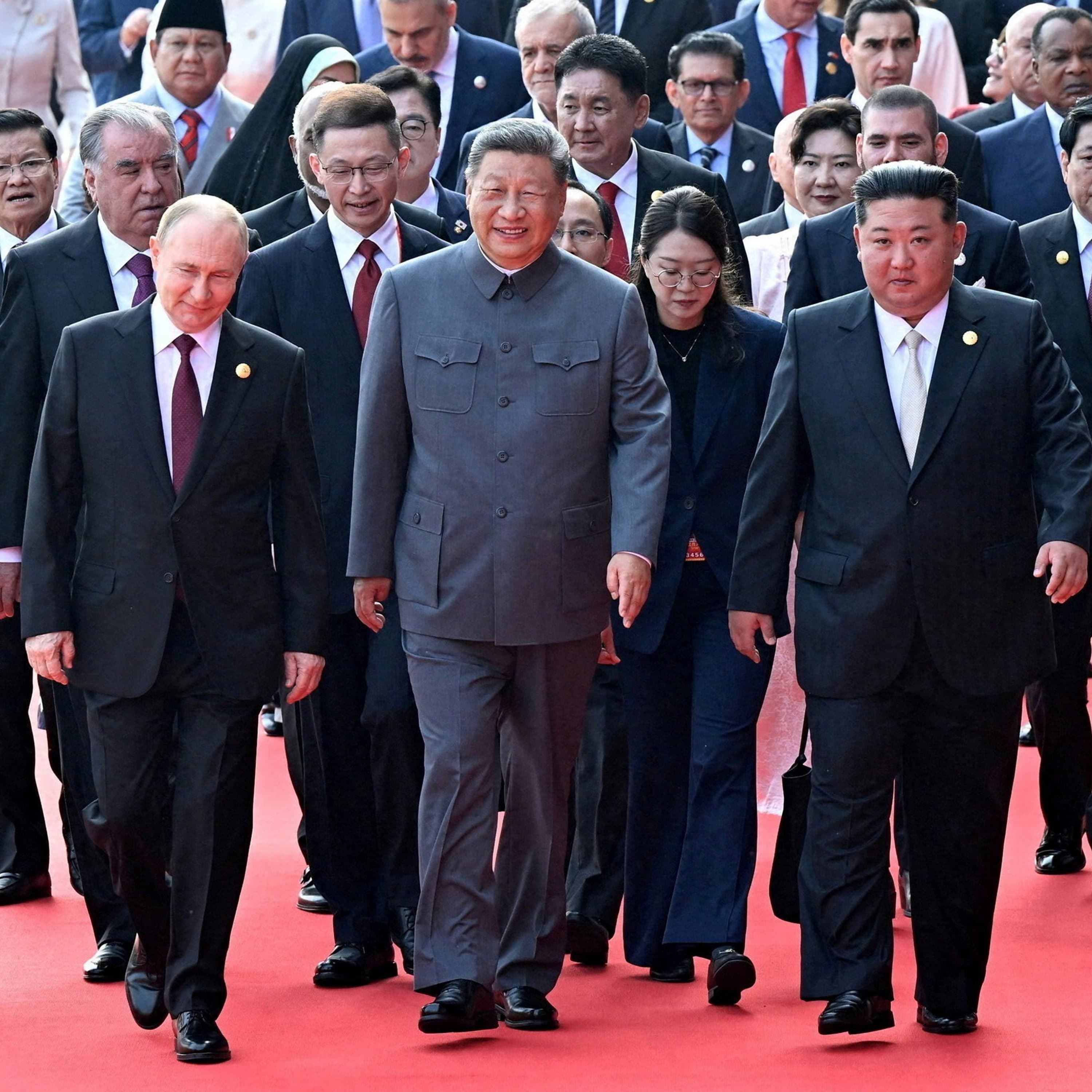
Xi, Kim and Putin: A new world alliance?Global News Podcast · Sep 4, 2025
Main Topic: The situation in Hong Kong, where protests have erupted again due to China's new national security law, which has been criticized for eroding Hong Kong's autonomy.
Key Points:
Participants:
Takeaways:
Theme music fades out
Sean Rameswaram
Support for Today Explained comes from Saks Fifth Avenue. Fall is here. Might be time to find some nice new pieces you can wear again and again. With Saks Fifth Avenue, it can be a breeze to shop for your personal style, like maybe a relaxed Prada blazer or Gucci loafers that are great for both work and the weekend.
Noel King
This is very Sean. This is very Sean-coated. Gucci loafers. Saks says Saks makes shopping feel totally customized to you, whether that's from an in-store stylist or a visit to Saks.com, where they can show you just what you want to see. They say they'll even let you know when arrivals from your favorite designers are in or when something you've been eyeing is back in stock.
Sean Rameswaram
You can find inspiration for your personal style every day at Saks Fifth Avenue.
Noel King
Support for this show comes from Strawberry.me. Be honest. Are you happy with your job? Or are you stuck in one you've outgrown? Or never wanted in the first place? Sure, you can probably list the reasons for staying. But are they actually just excuses for not leaving? Let a career coach from strawberry.me help you get unstuck. Discover the benefits of having a dedicated career coach in your corner. Go to strawberry.me slash unstuck to claim a special offer.
Sean Rameswaram
The streets of Hong Kong sound awfully familiar. It sounds a lot like last June, when massive protests erupted in Hong Kong.
Noel King
They were big. They involved millions of people. They were sometimes very violent.
Sean Rameswaram
After hours of chanting and song, police moved in to disperse the crowds. Barriers torn down, rubber bullets and tear gas fired into the chaos. Umbrellas and plastic bottles their only defense.
Noel King
Last year, the protests were driven by an extradition bill that would essentially allow criminals to be extradited over to mainland China from Hong Kong. The law would allow suspects to be sent to mainland China to face trial. Critics of the bill fear this could lead to arbitrary detention and unfair trials.
Sean Rameswaram
Last year's protests never really ended. They only started petering out during the onset of coronavirus when obviously people were afraid to gather en masse and kind of stayed at home. But two things have changed. One: coronavirus here is sort of no longer a major concern. There have been no local cases in a few weeks now.
Noel King
And two... Beijing has taken the opportunity of the world being distracted to essentially make huge moves here and rewrite the rules of Hong Kong.
Sean Rameswaram
China has drafted a new, sweeping national security law. It will criminalize foreign interference, successionism, subversion against the state, and all of these things are extremely broad.
Noel King
The law is the most dramatic in a series of attempts to erode Hong Kong's autonomy in recent years. In a statement, Secretary Mike Pompeo said that no reasonable person can assert today that Hong Kong maintains a high degree of autonomy from China, given the facts on the ground. This certification means the U.S. could revoke its special trade relationship with Hong Kong, which would hurt the economies of both Hong Kong and China.
Sean Rameswaram
And now, once again, the streets of Hong Kong are filled with protesters. You know, Hong Kong is back to normal in many ways. Restaurants are open, bars are open, and protests are back and tear gases back on the street, right? That's how normal.
Noel King
Shibani Matani, you're the Hong Kong bureau chief for The Washington Post, and you were at the protest this weekend. What was it like out there?
Shibani Matani
News of the new national security law broke kind of late last week. We will stop violence and restore order, Chairman Wong Young announced, suggesting the autonomy Hong Kong enjoys under one country, two systems, was no longer on the table. And already, immediately, we saw calls to protest.
Noel King
I mean, it only took me two interviews to find someone on the streets who had already been arrested before as part of last year's movement. And, you know, once you obviously get arrested, you know, the next time that happens to you again, you won't get bail and, you know, you'll be in a detention center somewhere.
Shibani Matani
And when I was on the subway, I saw like thousands and thousands of people and then when I got out, like the streets were all choked again. You couldn't move. There were people chanting the same slogans as last year but some different ones too Some were shouting Hong Kong independence the only way out.
Noel King
And I was really actually taken aback because it does seem to me that no matter what and no matter how hopeless the situation seems, like Hong Kong people still want to fight back. They still want to try to protect their rights and freedoms.
Shibani Matani
And it was only 20 minutes into the march that the police fired tear gas and tried to break it up. And even before the protests already started, more than a hundred police with the rubber bullets and the guns already used those equipment to crack down and to target the dissident in Hong Kong.
Noel King
There were scenes of chaos really reminiscent of last year. Last year, actually, especially in the beginning, they let these marches go on for hours and hours before they did make moves to clear it. So the pace was quite stunningly fast this time of them trying to break it up and get people off the streets.
Shibani Matani
You mentioned you spoke to protesters. I mean, did anything stand out from some of those conversations?
Noel King
For sure, their resolve and their insistence that they will literally die fighting remains the same. I think these protesters, a lot of them, like I said, are very young, but there's also an older generation that felt like they didn't do enough in 1997. They didn't do enough when Hong Kong was handed over back to China from the United Kingdom.
Shibani Matani
They felt like they let down the younger generation and they kind of let Hong Kong slowly get subsumed into China. They let its freedom slowly get eroded. And they're very emotional about that. And they really want to come out and try to protect the future of the younger generation.
Noel King
They basically feel like this is their last chance to fight back, to kind of stand up for what they believe Hong Kong should be. And a lot of them, you know, they keep repeating, we just want Hong Kong to be left alone. We just want Hong Kong to remain Hong Kong. We just want the freedoms we've always enjoyed. We just want the right to protest. And, you know, we want our children to have the same.
Shibani Matani
It all just kind of feels like deja vu. I mean, is it basically China just going one step further, trying to officially bring Hong Kong into the fold?
Noel King
Yeah, I mean, I think it's very much Beijing's response to the protests and the protest movement of last year. I think they have grown intolerant with Hong Kong. I think they've decided, you know, enough is enough. We have to find some way to basically, you know, crush this dissenting, you know, territory that's right on our border, right?
Shibani Matani
I think that they see this protest movement not something that's organic or something that's driven by Hong Kong, but a product of U.S. interference, foreign interference, that there are rabble rouses, people who want independence for Hong Kong, who are trying to essentially upend their national security.
Noel King
So I think they fought very strongly with this. And the most remarkable thing here is that instead of going through Hong Kong's legislation, instead of going through Hong Kong's processes, they've decided to impose this essentially unilaterally in Beijing.
Shibani Matani
That's been the thing that's really shocked many. If China can just do something drastic like this unilaterally, why didn't they do it last year? Why did they start with the extradition bill? This is the riskiest move that Beijing could take.
Noel King
It is certainly something that I think stunned all of us because the risk level is so high. I mean, presumably the economic impact and the political and geopolitical sort of just consequences, right, of Hong Kong losing its special status with the U.S. would be so far reaching.
Shibani Matani
And I don't think anyone could have imagined that Hong Kong would even be discussing this, right? The end of Hong Kong status as a global financial hub and, you know, the end of the U.S.-Hong Kong trade relationship.
Noel King
I think they severely underestimated what the response would be, right? I think they didn't think millions of people would come up to the streets. I think they didn't think that it would, you know, give birth to a whole new generation of activists, that, you know, they would see universities literally become, you know, Molotov cocktail factories and so on and so forth, right?
Shibani Matani
So I think the mistakes of last year have sort of prompted them to take this extremely bold and extremely risky move without really thinking about the international consequences.
Noel King
And the protests last year they were at least partially successful in that Hong Kong did end up withdrawing the extradition bill Is there any chance that these protests have a similar effect?
Shibani Matani
Yeah, it really interesting They were, but now it looks like China doesn't even need the extradition bill. They brought their law into Hong Kong, right? So they don't even need to extradite you there. They can just use their own laws here in Hong Kong.
Noel King
Beijing has sort of lost trust with Hong Kong's government and authorities. They know that they totally mishandled the crisis last year. And instead of responding in a way that made people stop protesting and, you know, quell the anger on the streets, it seemed like at every turn they inflamed the situation and made it worse.
Shibani Matani
So instead, I think what they're doing now is totally bypassing Hong Kong and their allies here even to just impose their will de facto from Beijing. And I think that will be something that will be much, much harder to fight back against.
Theme music fades in
Sean Rameswaram
Support for Today Explained comes from Chime. Nobody likes fees and complicated banking, says Chime. And Chime gets that, says Chime. Chime is a financial technology company that says they understand that every dollar counts. So when you set up direct deposit through Chime, they say you get access to fee-free features, such as free overdraft coverage, getting paid up to two days early with direct deposit, so much more.
Noel King
Chime says with qualifying direct deposits, you can be eligible for free overdraft, up to $200 on debit card purchases and cash withdrawals. Plus, they say you don't need to worry about monthly fees or maintenance fees. You can work on your financial goals through Chime today. You can open an account in two minutes at chime.com slash explained. That's chime.com slash explained. Chime feels like progress. Chime is a financial technology company, not a bank. Banking services and debit card provided by the Bancor Bank N.A. Or Stride Bank N.A. Members FDIC. Spot me eligibility requirements and overdraft limits apply. Timing depends on submission of payment file. Fees apply at out-of-network ATMs. Bank ranking and number of ATMs according to U.S. News and World Report 2023. Chime checking account required.
Sean Rameswaram
Why shop at Burlington? Maybe it's the deals that are new each time you drop by. Maybe it's the brand names you'll be shocked Burlington has in store. Or maybe it's the quality of the items, the amazing selection, and the newest trends. If you like to save but also like to stay in style, Burlington is your answer. And the question you'll be asking yourself is, why go anywhere else? Burlington. Deals. Brands. Wow.
Noel King
Shabani, this new national security law, it's been unveiled, but it hasn't taken effect yet. So how much do we actually know about what's in it?
Shibani Matani
So the specific details of the law are not actually public yet. And everyone's been trying to get more information on what exactly it means and the implications. But it is a national security law that will seek to criminalize a number of key things. Successionist behavior, which is anybody seeking independence for Hong Kong. Subversion of the state. any threats to national security, extremely broadly worded, and foreign interference, which is the thing that I think perhaps most concerning for, you know, diplomats, journalists, and others operating here.
Noel King
What actually counts as foreign interference? I mean, we don't have too many details, but could you, as a journalist, be punished for interviewing someone that the government doesn't approve of? Right. No one knows.
Shibani Matani
And I think that that is the concern, right? So I'm on the board here of the Foreign Correspondence Club. A few years ago, we hosted a Hong Kong independence activist. And Victor Mallett, who was the Financial Times Asia editor at the time, who was sort of the moderator of that, got his visa extension denied and had to leave Hong Kong very hastily. And that was before all these laws were in place, right? So now with those laws in place, does it mean that if we publish quotes from, say, an independence activist or a protester in the street who's advocating for independence or something that Beijing disapproves of or if we ourselves are considered the ones who are interfering and we are foreign journalists The implications are so sweeping and huge and broad And I don't think any of us have really sort of figured it out yet
Noel King
The timing of this new law can't be a coincidence, right? Is China using this pandemic as an opportunity to pass this new law?
Shibani Matani
Yeah, I think that's definitely what we're seeing, not just in Hong Kong, but across the region. In the past few months, China has made various moves to assert itself in the South China Sea, you know, with Vietnam. Taiwan. And, you know, we're seeing it now here in Hong Kong, too.
Noel King
I think, you know, Xi Jinping considers his handling of the pandemic a win. The CCP feels very emboldened right now. And they see the U.S. as weakened. And in that environment, they feel like they can push, you know, for things and hopefully have no one respond.
Shibani Matani
But I think Xi Jinping wants to call the U.S.'s bluff. I mean, he wants to see if they'll really do it and they'll really push back that strongly. I don't think that the fate of Hong Kong will necessarily be defined by the protests, but I think it will definitely be defined in large part by the reaction of the international community, especially the United States.
Noel King
And, you know, Secretary Pompeo reacted today saying that Hong Kong no longer warrants the same kind of special treatment it once had from the U.S. Do you think that could have any effect on China?
Shibani Matani
It's hard to say definitively just because the U.S.-China Cold War here, The new Cold War has taken up so much bandwidth in Washington. And already there's been such a huge push for some of these measures, right? The sanctions, the rethinking of Hong Kong special status and everything else.
Noel King
And I think the protest environment adds more of an unknown, right? Because the more people protest in the streets, the more violence there is, the more images of barricades and tear gas and police having projectiles thrown at them and stuff. The more Beijing will say, you see, this is exactly why we need this national security law. And then it just sort of spirals downwards, right?
Shibani Matani
So I think everyone's kind of predicting a very, very difficult summer over here in Hong Kong.
Noel King
Just how risky is this for China? Could the whole thing fail?
Shibani Matani
Yeah. I mean, already China's economy is hurting because of the impact of COVID. And there is also separately a move in Washington to kind of delist Chinese companies, you know, from the stock exchange, right? So they need Hong Kong, right? They need Hong Kong's, you know, capital. They need Hong Kong as the international hub of finance and trade that it's always been, right?
Noel King
And I don't know how quickly that will end or whether that will happen in stages or it's very hard to kind of see what the future will be there. But China certainly benefits a lot from Hong Kong. And so if that no longer is the case, economically, it could have huge, huge impacts, I think.
Shibani Matani
But I think they're just making the calculation now that Hong Kong protesters are too much like, you know, Xinjiang and Tibet. They're like a restive region that needs to be kept under control. And I think maybe that's a bigger calculation for them right now than the economic factors.
Noel King
Yeah, with Tibet and Xinjiang, I mean, these aren't exactly economic powerhouses. If China's able to do something like this with an economic powerhouse like Hong Kong, what does that mean for China's standing in the world order?
Shibani Matani
Yeah, that's a very good question. I mean, the Hong Kong protesters will tell you, you know, first Hong Kong, then the world, right? They'll say, if they can do this to us, you're going to be next. We're like Berlin, 1989, like watch us to see which way the world's going to go.
Noel King
They've always framed their struggle that way. They've always seen themselves as between a sort of liberal, democratic order that they're trying to uphold and protect and this regime that wants to kind of crush them.
Shibani Matani
So that's what they would say, I guess, that it would be us first and then the rest of the world.
Sean Rameswaram
Shabani Matani is the Hong Kong bureau chief for The Washington Post. I'm Noam Hassenfeld, filling in for Sean Ramas for him. This is Today Explained.

