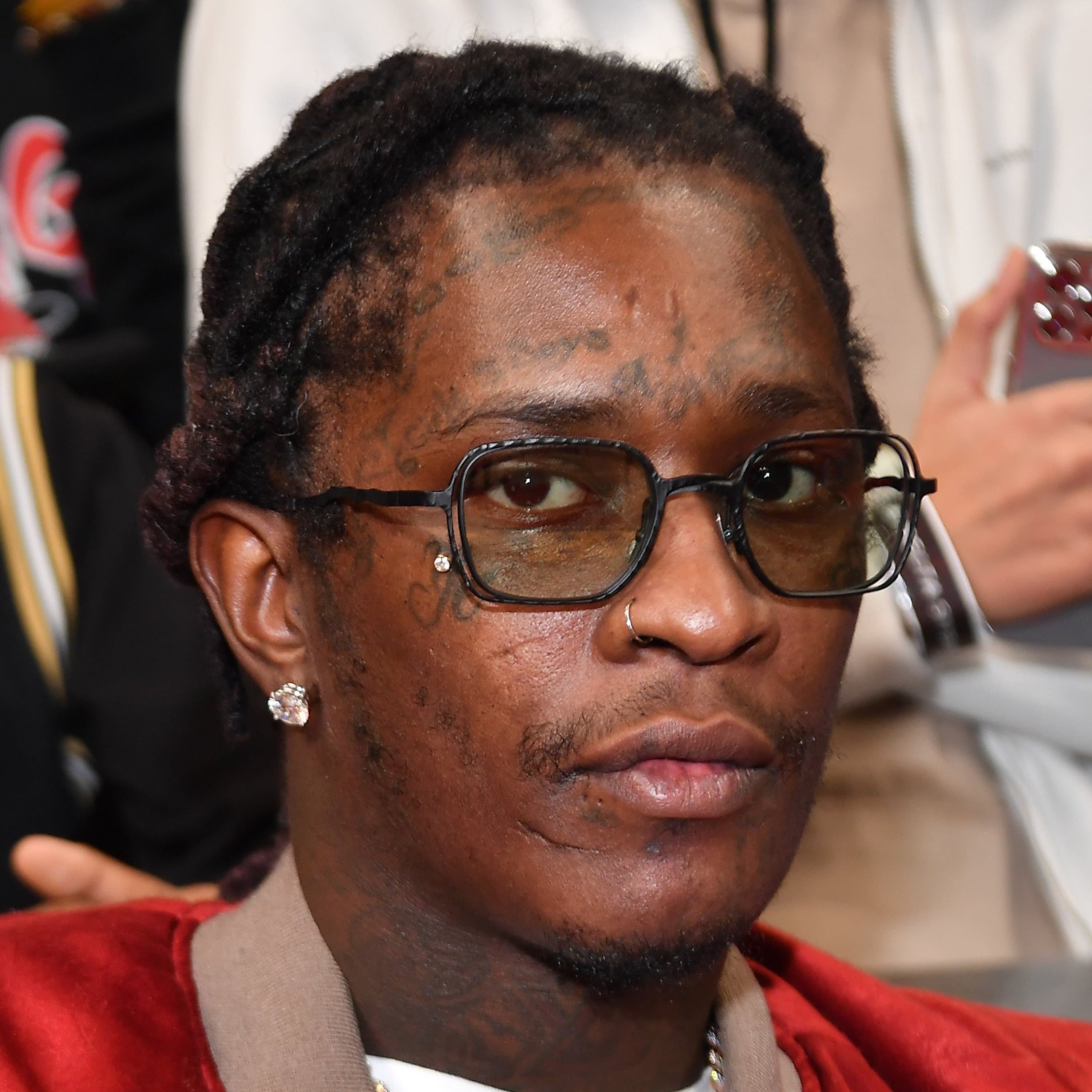
--:-- Sean Rameswaram: A funny thing happens in the new Drake video for his song Sticky. After watching the Canadian rapper wrap up a show, we see him stunting next to luxury vehicles and boarding a private jet. Next, he's helming a sailboat, just regular rapper stuff. But right as he says, you see free YSL written in big neon green slime dripping on your screen. It's kind of jarring and doesn't really gel with anything else happening in the song or the video. But the most popular rapper in the world is taking a beat to plea for the release of one of the most popular rappers in the world. Big Slime is an alias for Young Thug. He and Gunna, another wildly popular rapper, are behind bars awaiting trial and their bars might be used against them. That's coming up on Today Explained.
--:-- [Sound effects: Music plays]
--:-- Sean Rameswaram: Focus on the work that matters most. I've never met an AI agent. Learn how ServiceNow puts AI to work for people at servicenow.com.
--:-- [Sound effects: Music continues]
--:-- Sean Rameswaram: Support for this show comes from Macy's. Layering is an art form. All it takes is a bit of intention, style, and, of course, the perfect cold weather staples. So find the perfect look for you with the help of Macy's Fall Fashion Guide, your one-stop shop for fall's latest trends and must-haves, curated by their experts. From leather to denim to cozy knits, find everything you need to piece together your new fall look. Explore the Macy's Fall Guide for yourself and shop in-store or online at Macy's.com.
--:-- [Sound effects: Music continues]
--:-- Sean Rameswaram: Hey, just a heads up, today's show has lots of strong language. Today, today explained. We wanted to know what's going on with Young Thug and Gunna, why two of the most popular rappers in America are behind bars and why their bars might be used against them in court. So we reached out to Jewel Wicker. She's the editor-at-large for Capital B in Atlanta.
--:-- Jewel Wicker: I'm based in Atlanta, Georgia, born and raised here, and I've worked here for at least five, six years.
--:-- Sean Rameswaram: So Young Thug is an Atlanta rapper. He's been around for about a decade now, first kind of as a local radio star and then breaking out on the national scene with songs like Stoner. You know, he's really made a name for himself, not just as an artist who kind of utilizes his voice and melodies in some really unique ways. He's also pretty prolific. So, for example, in 2020 alone, he racked up 14 hits on the Billboard Hot 100. And that's despite not releasing a solo project that year. He's also notably the founder of a very successful music label called Young Stoner Life, or YSL. And one of the biggest acts on that label is a rapper named Gunna.
--:-- Jewel Wicker: Gunna's rap style is certainly a nod to Young Thug, but he's also really been able to make a name for himself as a solo artist with songs like Drip Too Hard, which features Lil Baby. And it's also worth noting that both men are kind of really popular on the fashion scene as well.
--:-- Sean Rameswaram: Yeah, Young Thug has a really distinct style, right?
--:-- Jewel Wicker: Yeah, Young Thug has a really distinct style. I mean, I think, you know, one of the album artworks of his that went viral, he was wearing a dress, which, you know, was really a controversial big thing at the time. Way before Brad Pitt wore a dress.
--:-- Sean Rameswaram: Oh, yeah. Way before Brad Pitt.
--:-- Jewel Wicker: And then Gunna, I mean, big enough that I profiled him for GQ earlier this year. And a part of the peg for the profile was like his closet, a look inside his closet at what he's wearing and kind of the fashion sense that he has.
--:-- Sean Rameswaram: Wasn't Gunna like a musical guest on SNL at some point?
--:-- Jewel Wicker: Ladies and gentlemen, Gunna. Oh, yeah, he had a number one album this year.
--:-- Sean Rameswaram: You know, we talk about Young Thug, and I think it is true that he's one of the biggest rappers in the world. But Gunna certainly is more than his protege.
--:-- Jewel Wicker: You know, when I profiled him earlier this year, it was fresh off the heels of him receiving a number one album. He came out with a viral hit, Pushing P, that a bunch of brands and artists kind of jumped on that train. He's really, really popular.
--:-- Sean Rameswaram: We don't want no peace. Got a spot, a cross spot. Just a piece. Dropped a dot and now we plattin'. Exited peace. She not a lesbian for a piece. She turned pizzie. Push a P. I'm Pusha P. A capital P. I write a president. Count president.
--:-- Jewel Wicker: So what is going on with these two guys right now? Why are we talking about them?
--:-- Sean Rameswaram: You know, so on May 9th, Young Thug was arrested at his home in Atlanta. and he was booked into the Fulton County Jail and charged with conspiracy to violate the RICO Act. The rapper and 28 other defendants charged in a 56-count indictment, alleging street gang activity, including robbery and murder. And then two days later, Gunna also surrendered and turned himself into authorities for the same thing. He's also facing RICO charges.
--:-- Jewel Wicker: Okay, and people who watch, like, mob movies or The Sopranos have probably heard of RICO charges. Since you are at the helm, it all gets back to putting up bigger blinds, really limiting your exposure to potential RICO boobos.
--:-- Sean Rameswaram: The only way to run a family these days is bunker style. You pee route through the slit. Mumsies.
--:-- Jewel Wicker: For those people who don't, what are RICO charges?
--:-- Sean Rameswaram: So they're being charged on the state level, but RICO itself is the Rocketeer Influenced and Corrupt Organizations Act. It started out as a federal law but now almost all states including Georgia have adopted similar state RICO laws And Georgia law is of course based on the federal act which has been used to target mafia families like the Gambinos It focuses on organized crime and only requires the state to prove that some group of people are committing a pattern of crimes
--:-- Jewel Wicker: Are Young Thug and Gunna in the mafia?
--:-- Sean Rameswaram: So it's being alleged that they're a part of an organized gang. That's kind of the basis of these charges. In this particular case, because he had this record label, they're alleging that through the record label, he was able to create this criminal enterprise to further this criminal activity in violation of the RICO Act.
--:-- Jewel Wicker: So prosecutors are really alleging that they are part of a gang that has committed a number of crimes throughout Atlanta, right? They are committing conservatively 75 to 80 percent of all of the violent crime that we are seeing within our community.
--:-- Sean Rameswaram: This is kind of a hybrid gang made up of Bloods and Crips, and together they've committed crimes that are in furtherance of this gang. That's what they're alleging.
--:-- Jewel Wicker: As large as this indictment is, I told my team that let's not be sexy, let's not overreach. Let's be conservative in our approach, which is always the approach that I take. And in taking that approach, 28 defendants were indicted, and they were indicted for the crimes that I believe were appropriate for this RICO indictment.
--:-- Sean Rameswaram: I mean, it's worth noting that prosecutors are alleging that Gunn and Young Thug aren't just a member of this gang, but that they're the leaders of it. But there were other people named in this indictment, a rapper named YSL Duke, a rapper named Yak Gotti, and a rapper named Un Funk. Again, all a part of this really large indictment that came down in May.
--:-- Jewel Wicker: Hmm. Okay. What is this YSL gang being accused of doing exactly?
--:-- Sean Rameswaram: It's worth noting that, one, there is a debate over what YSL is. Uh, prosecutors say YSL stands for Young Slime Life. Uh, Young Thug and people in the rap industry say it stands for Young Stoner Life. Prosecutors, of course, allege that Young Slime Life predates and, uh, existed long before the record label itself.
--:-- Jewel Wicker: But they're saying that the people in the gang, including Young Thug and Gunna, have committed a number of crimes. And the allegations in this indictment really range from wearing a chain in a music video and kind of repping YSL, which they, of course, argue is a record label, to, say, purchasing a car that is then used in the commission of a murder.
--:-- Sean Rameswaram: And some of these charges are still being brought down. So say Young Thug, for instance, was just charged with six more things in relation to his arrest earlier this month. They include participation in criminal street gang activity, possession of marijuana with intent to distribute, possession of codeine with intent to distribute, possession of cocaine, possession of a firearm during the commission of a crime and possession of a machine gun.
--:-- Jewel Wicker: So this is in addition to the original indictment that we saw in May. Right. That's important because we're still seeing charges being added to to kind of what prosecutors are alleging here. And they're still in jail. They've been in jail this entire time since May.
--:-- Sean Rameswaram: We've had a couple of bond hearings so far. The judge every time is denied bond kind of citing fear of witness intimidation. And Gunna turned 29, you know, since he's been in jail. And he released a letter that kind of proclaimed his innocence and really leaned in heavy on what we think defense attorneys are going to use. Kind of this idea that black art and lyrics are being used unfairly to criminalize these men.
--:-- Jewel Wicker: Tell me more about that. Is that like a big part of this case here that they're going to be using Young Thug and Gunna's lyrics?
--:-- Sean Rameswaram: Yeah, I mean, it was used several times in the indictment, and it also has come up several times in some of the bond hearings, you know, several songs like Take It To Trials. Husky. Yeah, yeah. I fuck with slacks and we coming to E-Rax and I came with some fucking piranhas. Gladdy. Yeah, yeah. I got a bag. That ain't enough. My leverage gleam. Yeah, that is tough. I killed this man. I'm frontin' this mama. I fuck lil' bruh. So, stand it gone, now, kick my shit.
--:-- Jewel Wicker: One of the lyrics from anybody that Young Thug raps is, I never killed anybody, but I got something to do with that body. And prosecutors have brought up several times in hearings that we've had so far that they allege that Young Thug is the leader of YSL, the criminal street gang. They don't think that he has necessarily gone out and murdered someone himself, but that he is the one that is kind of orchestrating and giving permission for these crimes to be committed.
--:-- Sean Rameswaram: So they're specifically leaning into this lyric because they're saying it's proof that what they're alleging is true.
--:-- Jewel Wicker: The question of whether or not rap lyrics should be admissible in court in a minute on Today Explained.
--:-- [Sound effects: Music plays]
--:-- Sean Rameswaram: Support for Today Explained comes from Chime. Nobody likes fees and complicated banking, says Chime. And Chime gets that, says Chime. Chime is a financial technology company that says they understand that every dollar counts. So when you set up direct deposit through Chime, they say you get access to fee-free features such as free overdraft coverage, getting paid up to two days early with direct deposit, so much more.
--:-- [Sound effects: Music continues]
--:-- Sean Rameswaram: Chime says with qualifying direct deposits, you can be eligible for free overdraft, up to $200 on debit card purchases and cash withdrawals. Plus, they say you don't need to worry about monthly fees or maintenance fees. You can work on your financial goals through Chime today. You can open an account in two minutes at Chime.com slash explained. That's Chime.com slash explained. Chime feels like progress.
--:-- [Sound effects: Music continues]
--:-- Sean Rameswaram: Chime is a financial technology company, not a bank. Banking services and debit card provided by the Bancor Bank NA or Stride Bank NA. Members FDIC. Spot me eligibility requirements and overdraft limits apply. Timing depends on submission of payment file. Fees apply at out-of-network ATMs. Bank ranking and number of ATMs according to U.S. News and World Report 2023. Chime checking account required.
--:-- [Sound effects: Music continues]
--:-- Sean Rameswaram: Let's be honest. Are you happy with your job? Like, really happy? The unfortunate fact is that a huge number of people can't say yes to that. Far too many of us are stuck in a job we've outgrown, or one we never wanted in the first place. But still we stick it out And we give reasons like what if the next move is even worse I already put years into this place And maybe the most common one isn everyone kind of miserable at work But there's a difference between reasons for staying and excuses for not leaving.
--:-- [Sound effects: Music continues]
--:-- Sean Rameswaram: It's time to get unstuck. It's time for Strawberry.me. They match you with a certified career coach who helps you go from where you are to where you actually want to be. Your coach helps you get clear on your goals, create a plan, build your confidence, and keeps you accountable along the way. So don't leave your career to chance. Take action and own your future with a professional coach in your corner. Go to strawberry.me slash unstuck to claim a special offer. That's strawberry.me slash unstuck.
--:-- [Sound effects: Music continues]
--:-- Sean Rameswaram: You know, rap is free speech. Rap is poetry. It's literature. It's drama. It's storytelling. And it should not be criminalized. Today Explained, we're back. And we want to talk about whether rap lyrics should even be admissible in court. And if so, in what context? We reached out to an academic who's also a lawyer to find out.
--:-- [Sound effects: Music continues]
--:-- Sean Rameswaram: My name is Timothy Welbeck. I am the director for the Anti-Racism Center at Temple University. I'm also an Africology professor there and civil rights attorney in Philadelphia. Professor Timothy Welbeck also happens to be a bit of a rapper.
--:-- Timothy Welbeck: I do rap.
--:-- Sean Rameswaram: So it won't surprise you that he's not crazy about this idea of prosecuting rappers with their art.
--:-- Timothy Welbeck: As a whole, I generally discourage the practice. I particularly take issue with it because at its core, rap lyrics are a form of artistic expression. And it's a medium in which people not only communicate their lived experience, but also delve deeply into their imagination as well.
--:-- Sean Rameswaram: And so we want to give them liberty to do that. And so then to have people create this genuine form of art and then to potentially suffer some type of punishment as a result of it is what I find to be troubling. particularly because of the racial dynamics to it, too.
--:-- Timothy Welbeck: This has been a debate that's been going on for decades. Tell me about that history. Where does it start?
--:-- Sean Rameswaram: So it starts back in the 90s. It actually even begins before that. So if you'll remember, circa the late 80s, we began to see a rise of a different level of content that was beginning to enter into the popular space, beginning with Schoolie D's PSK. I.T.'s 6 in the morning. Then N.W.A.'s catalog. It began to create a shift in not only the type of music that was coming out, but how it was speaking to certain social conditions.
--:-- Timothy Welbeck: And very quickly, people began to term that gangster rap. And if you may remember, Tipper Gore, among others, began having a campaign around trying to censor gangster rap and painted as something that was untenable for public consumption.
--:-- Sean Rameswaram: There's songs about rape, thrill killing, sadomasochism. There's a song that goes, quote, not a woman but a whore, I can taste the hate. Well, now I'm killing you. Watch your face turning blue, unquote, by a group that has sold two million copies of that particular album.
--:-- Timothy Welbeck: And so as that debate continued raging into the early 90s, you began to see prosecutors using rap lyrics as a form of evidence against people in trial. You also have prosecutors literally saying these rap lyrics are almost like party confessions.
--:-- Sean Rameswaram: What is maybe one of the more prominent cases that's come forward that used an artist's lyrics against the artist in a trial?
--:-- Timothy Welbeck: Draco the Ruler and Tay-K are, I think, two cases that really caught people's attention, particularly with Draco the Ruler. Prosecutors allege that Caldwell was a part of a botched plot to kill a rival at a party he attended in December 2016. Allegedly in the midst of a shootout, he and his gang had accidentally murdered 24-year-old Davion Gregory.
--:-- Sean Rameswaram: But notwithstanding, his lyrics were used in trial as a means in which to establish a motive and saying that the person who was killed was killed in part because they had a longstanding beef with him.
--:-- Timothy Welbeck: And this beef that he had was something that he articulated in his music. Everything I state is facts. I'm not these other street niggas, but Chaka really rap. I'm riding around town with a Tommy gun and a jag and you can disregard the yelling RJ Todd up in the back. Man, stop.
--:-- Sean Rameswaram: And so as a consequence of him articulating this in the music, people were trying to use that in trial.
--:-- Timothy Welbeck: How successful have prosecutors been using this approach? Do the lyrics sort of tip the scales in their favor? Are they winning cases?
--:-- Sean Rameswaram: So you have to even have the court agree that these lyrics can be introduced as evidence. And so many defense attorneys have argued that lyrics are immaterial, they're irrelevant, they're prejudicial, things like that. And defense attorneys in most of these cases that I just mentioned have lost those motions trying to suppress that type of evidence to try to keep it out of trial.
--:-- Timothy Welbeck: And now that they're used in trial, how influential are they for the jury? And it seems as though in some of these cases, they are having an impact on how the jury is weighing the evidence.
--:-- Sean Rameswaram: And if nothing else, when used in court, the thing that many people are arguing about is how they're painting a narrative about some of these rappers and the genre of rap as a whole, rappers themselves as individuals. and then particularly those who are standing trial, is getting people to believe that they're predisposed to committing certain criminal acts, even if these are entirely fictitious accounts or forms of artistic expression and the like.
--:-- Timothy Welbeck: Have there been cases where the art wasn fictitious I think about you know where is the line If a rapper says you know I killed Mike on 354 State Street and then they go to 354 State Street and they find Mike there, is that something that can be further investigated? Or should there be this, you know, golden rule that, well, that was art, man. You can't be using the art in court, you know?
--:-- Sean Rameswaram: That's where a lot of the debate hinges. And what most people will say is that if you make a specific claim in lyrics that point to a specific crime that only the person who committed the crime could have known, you should reasonably expect that your lyrics will be used against you.
--:-- Timothy Welbeck: As MF Doom said, you'd be a rap snitcher telling all your business, going in the court, be your own star witness. And be their own star witness. Do you see the perpetrator? Yeah, I'm right here. Fuck around. Get the whole label sent up for years.
--:-- Sean Rameswaram: So like, in that instance, it's permissible and it makes sense. But what most people are decrying is the broader sense in which rap lyrics are used to paint a narrative about these young black men and women who have a predisposition to commit criminal offenses. They're inclined to be inherently violent. And as a consequence, you can use their lyrics almost to a sole degree as a form of evidence. That's what people have an issue with.
--:-- Timothy Welbeck: So when you look at criminal proceedings, what we have to weigh is that the court, if they're successful, are going to deprive you of your life, your liberty, or your property. And so in order to do that, they have to meet a burden of proof. They have to establish that you committed a crime beyond reasonable doubt. And to only base that on rap lyrics is insufficient.
--:-- Sean Rameswaram: Where do you think we're heading with Young Thug and Gunna, two of the biggest rappers in the United States and thus the world?
--:-- Timothy Welbeck: I think it's different with each of them. So on its face, the initial indictment I thought was lazy in some of its presumptions and the indictment that originally was made public. I think here they may have gone a step too far because they're charging these individuals with criminal activity, crimes under Georgia law, which really may be limited to just things they've said, either on social media or in song lyrics. And ultimately, I think that's going to be a problem.
--:-- Sean Rameswaram: I think what has shifted, I guess, our analysis and the time there since is that we have learned that there are people who are willing to testify against Young Thug. And there's other evidence that they believe, the prosecution believes that they have that they can use against him. I think that's what shifts the scales against Thug.
--:-- Timothy Welbeck: And regrettably, he is facing potentially some serious time in prison based on if, again, the prosecution can prove that beyond a reasonable doubt. But what I'm saying is that it appears as though the prosecution, at the very least with Thug, has more evidence against him than just his lyrics.
--:-- Sean Rameswaram: For people who are struggling to wrap their heads around why someone like Young Thug would be wrapped up in potentially, you know, Rico cases and gang violence, what's going on there? Is there something about where he's from that doesn't allow him to escape?
--:-- Timothy Welbeck: I'll say a couple of things to that. Young Thug in particular and many rappers more broadly come from some of the most marginalized communities in all of the country. They're in some of the most least desirable parts of cities that have been laid to waste by urban neglect and other discriminatory policies.
--:-- Sean Rameswaram: And so it makes sense then that hip hop, a culture that emerged from the inner city in the U.S., is going to be predominated by people who come from these types of circumstances and at times document their lived experience in their music, even if they take creative license.
--:-- Timothy Welbeck: To put it succinctly, when you've got someone like Thug coming from the trap and your living condition looks like a trap, it's going to be difficult for you to make it out outside of a box or in a cage. And Young Thug did the miraculous and did that. And he was trying to bring a lot of his people with him. And some of those people did not have the same access that some of his colleagues' networks may have had access to. And that's not necessarily something we should punish them for.
--:-- Sean Rameswaram: And so with that, I hope that Thug continues to get a fair trial. I hope his legal counsel mounts a vigorous defense for him. And we'll see what happens from there.
--:-- [Sound effects: Music continues]
--:-- Sean Rameswaram: Professor Timothy Welbeck, he's the director for the Anti-Racism Center at Temple University. He's a civil rights attorney in Philadelphia. And he's a rapper wherever you listen. and he goes by Timothy Welbeck.
--:-- Timothy Welbeck: I go by Sean Ramos for him.
--:-- Sean Rameswaram: Early in the show, you heard from Jewel Wicker from Capital B. Our producer goes by Hadi Mawagdi. Our fact checker is Laura Bullard. And Nafim Shapiro mixed and mastered this episode of Today Explained.
--:-- [Sound effects: Music continues]
--:-- Sean Rameswaram: I always knew it I'd be great Cause my coach told me I was slow, but I was running at a fast pace They trying to divide us and conquer the world with it They got a couple of the guys and all of the girls with it But I'm a mastermind, I see right through it I see that you got a couple of diamonds and the rest of pearls in it. They say you're poking too black right to your face. They say where you live, you'll never be able to own that place. My father said you can change it all with your performance. And by the way, your life's a baby's don't charm. They take the land and they protect who I can come. But I tell you what a long sleeve I've been on. I'm high enough to be on the Milky Way tomorrow. If you want it, you go get up earlier than any morning. If you want it, you gon' be a burly The little one Put on my socks, grab my Glock The stick under the couch, tie off my shoes In flip flops, and it's top of the top R.P. Nielsen, you know what I'm saying? If you were the one in my shoes Would you love? Would you love? Would you love? If you were the one in my shoes Would you love? Thank you.