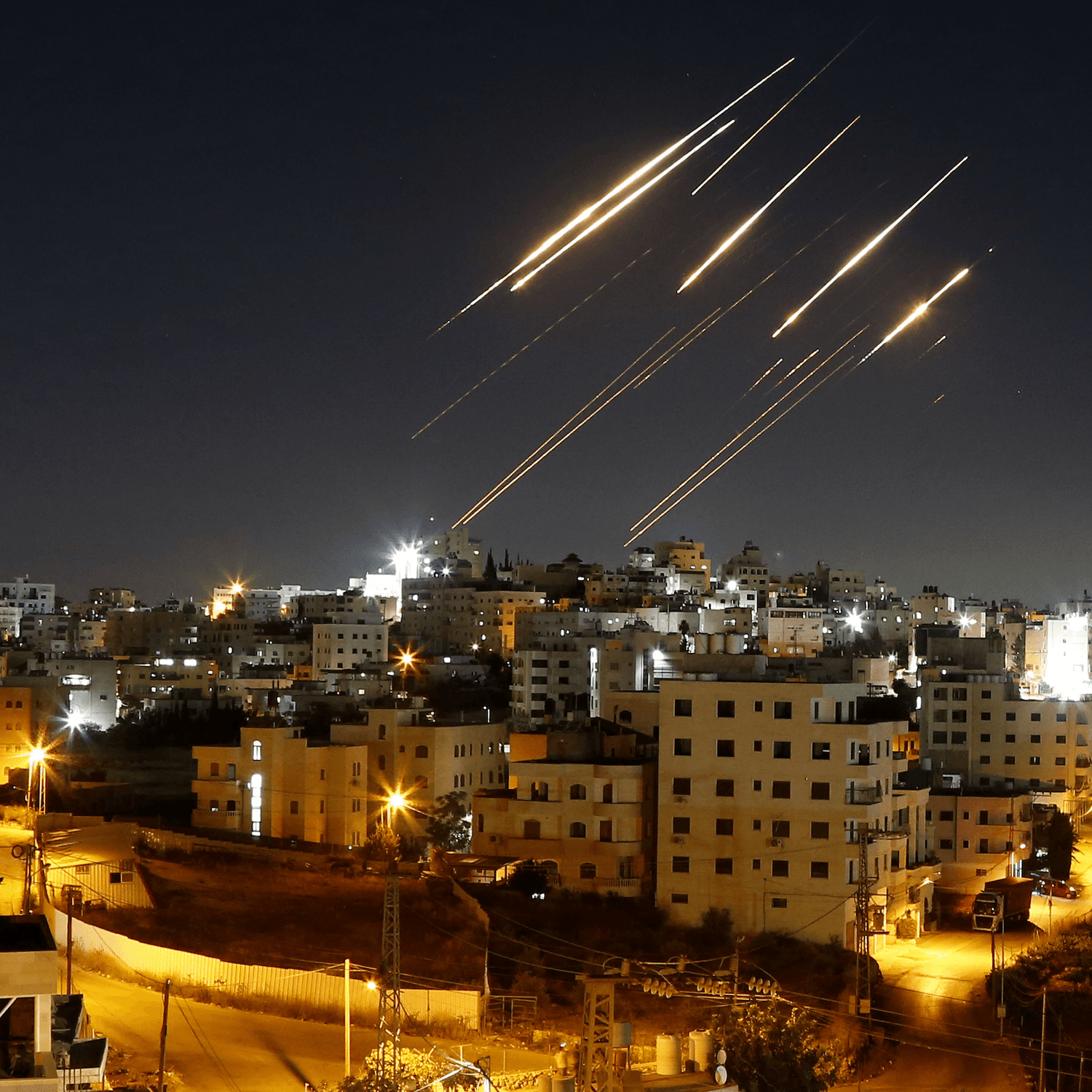
--:-- Sean Rameswaram: This weekend, Iran launched more than 300 drones and missiles at Israel. It was an unprecedented direct attack on Israel from Iranian soil. On the other hand, zero people died and not a single drone entered Israeli airspace. But it really does hint at a broader regional conflict. Iran launched the drones from not only its territory, but also Iraq, Lebanon, and Yemen. And on the other hand, Saudi Arabia and Jordan joined the United States, the United Kingdom, and Israel in shooting the drones down. But surely it suggests that this war in Gaza will continue to escalate beyond Gaza. This is by definition an escalation. But on the other hand, it's been like 48 hours and Israel doesn't seem to be doing anything. If we're being honest, this whole situation feels a little confusing.
--:-- [Support for Today Explained from Adio]
--:-- Sean Rameswaram: We're going to try and help you understand it on Today Explained. Support for Today Explained comes from Adio. Adio is an AI-native customer relationship management platform that Adio says is built for the next era of companies. A powerful data structure adapts to your business model, syncs in all your contacts in minutes, and enriches your business with actionable data. Adio says it also allows you to create those email sequences, those real-time reports, those powerful automations, which they claim can help you build what matters most, your company. You can go to adio.com slash todayexplained to get 15% off your first year.
--:-- Gregg Carlstrom: Having a night out with your friends is awesome. Dealing with hangovers sucks. Meet Senorita, the THC-infused margarita that lets you skip the booze but keep the vibe. Made with real fruit, organic agave, and Himalayan pink salt, every sip is like a mini getaway. No fillers, no hangovers, just full flavor and a better buzz. Find your flavor at senoritadrinks.com. Use code VOX20 for 20% off. Must be 21 and over. This product may cause intoxication. This product has not been evaluated or approved by the FDA. This product may contain up to 0.3% THC.
--:-- Sean Rameswaram: Today Explained, Sean Ramos from Greg Karlstrom is the Middle East correspondent for leading magazine The Economist, which means he had a very busy weekend. But before we get into this past weekend's fireworks, we asked him to remind us how this war in Gaza has spilled out into the region because it's worth remembering there has been a fair amount of activity outside of Palestine. That would be an understatement, I think, yes. I mean, if you go sort of clockwise around Israel, you've had near-daily rocket fire from Hezbollah in Lebanon and then Israeli airstrikes and shelling in Lebanon. The IDF was also involved in very heavy back-and-forth fighting with Hezbollah. You've had intermittent attacks from groups in Syria and then a very heavy campaign of Israeli airstrikes on Syria. You've had militias in Iraq who have fired drones at Israel and also attacked American troops in the region.
--:-- Gregg Carlstrom: Cautionary words from President Biden who says the U.S. shall respond after Iranian-backed militants killed three American service personnel and injured at least 30, all stationed in Jordan. You have the Houthis in Yemen who have also fired drones at Israel and then carried out this quasi-blockade of the Red Sea by attacking commercial shipping. These attacks are reckless, dangerous, and they violate international law. There's been a lot of talk lately about whether or not this could turn into a regional war. But I think by any metric, it already is a regional war. It has been for months now. And it's just a question of whether it becomes an even bigger one than it already is. And it did become a bigger one this weekend.
--:-- Sean Rameswaram: Can you tell us, of all these regional issues that you just referred to, which ones were most sort of germane to the lead up of what happened this weekend with Iran? It was Syria. And there was a proximate cause for it. And then there was a months long backdrop to it. So the immediate trigger for what happened this weekend was an airstrike, an Israeli airstrike on April 1st on Iran's embassy compound in Damascus. Damascus, General Mohammad Reza Zahedi was confirmed dead. He was the commander of the Iranian Islamic Revolutionary Guard Corps at Quds Brigades. And that means he was in charge. It wasn't just the death toll that was significant about that. It was the choice of target. It was the fact that Israel bombed a consular building. But it also wasn't just one airstrike. It came after months and months and months of Israeli strikes on Iranian targets. Since October the 7th, it's carried out an unusually heavy, compared to past years, an unusually heavy campaign of airstrikes against Iranian targets. And so this was the straw that broke the camel's back, if you will, but it was part of a much bigger Israeli campaign there.
--:-- Sean Rameswaram: Now, we're talking Monday morning, 9 a.m. East Coast. How has Israel responded so far? It hasn't yet, partly because it can't agree on how to respond. As world leaders call for restraint, Israel's war cabinet met without announcing any definite course of action, but said it would respond at a time and in the manner of its choosing. Part of the reason they can't agree is they're under a lot of pressure now from both their Western allies and friendly countries in the Arab world who are worried that if Israel strikes back against Iran directly, Iran might retaliate and we might be in this tit-for-tat cycle that will lead to that much bigger regional war that everyone is afraid of. So there's a tremendous amount of pressure on Israel from from its allies abroad, at least to slow down, to think about what it's going to do and to not rush into what could be a very rash reprisal. President Biden says he will convene a meeting of the group of seven leaders today. On Saturday, he spoke with Israeli Prime Minister Netanyahu and reaffirmed America's ironclad commitment to the security of Israel. A senior administration official tells NBC News he also urged Netanyahu not to retaliate but, quote, take the win. The Americans and the Brits and the French and other countries were all very happy to come to Israel's defense here and act on its behalf defensively. But they have no interest whatsoever in this turning into a bigger regional conflict that might draw them in in a more significant way.
--:-- Gregg Carlstrom: Do we have any sense of whether Netanyahu listening to Joe Biden here or just making the decision Joe Biden wants on you know his own accord I think it always fair to doubt that Netanyahu is listening to Joe Biden. I mean, what we've seen over the past six months since October 7th is just about everything that Joe Biden has asked Israel to do, whether it's allowing more humanitarian aid into Gaza, talking about a possible diplomatic process to follow the war. All of these things that Biden has pushed for, he's been rebuffed. And so we've had months and months of leaks about how he's frustrated with Netanyahu and he's fed up with the Israeli government. But that also hasn't translated into action, into policy change in Washington. So there is a lot of skepticism, I think, that the Israeli government in this case will listen to the Americans. But at the same time, there are people within the Israeli government, I think, who recognize that they owe a debt to their allies at this point, that they would not have been able to shoot down 99% of these Iranian missiles and drones without very significant help from the United States and from other partners around the world. And because of that, and because they would need American help if they were to retaliate against Iran and perhaps be attacked again, they would need American help again to defend against that. So I think at least in parts of the Israeli government, there is a recognition that they can't just blunder into a response here, that they do have to consult with their allies before they do anything.
--:-- Sean Rameswaram: What was the point of this unprecedented drone strike that was essentially a huge failure? Iran could have surely done something that would have hurt Israel more. Did it purposely take a sort of benign tack? I think Iran was trying to juggle two different priorities or two different objectives that ultimately could not be reconciled. On the one hand, it felt it needed to do something, both because of domestic pressure from hardliners in the government and in the military who demanded a response, and so the government felt like it needed to appease them, and to restore deterrence against Israel, to send a message to Israel that this attack on the consular building went too far and couldn't be repeated. So they were trying to do that, but simultaneously they were trying to do it in such a way that wouldn't automatically trigger a massive Israeli counterattack and lead to a big war on Iranian soil, which is something they've always sought to avoid. And that's why they telegraphed this for two weeks. They made it known that there was going to be some sort of retaliation, and they gave Israel and its allies time to prepare. And then they began the attack with these very slow-moving drones that they launched from Iran that took hours and hours and hours before they actually reached Israeli territory, which gave everyone a heads up that the attack was underway and they needed to scramble fighter jets and prepare their air defenses. They were trying to do these two things, and ultimately they couldn't reconcile those two objectives. And so they went with this big attack to satisfy a domestic constituency and try to impose deterrence on Israel. But they telegraphed the big attack, which made it militarily ineffective. And I think they ended up, strategically speaking, you know, in the worst of all possible worlds.
--:-- Sean Rameswaram: Is there any way of knowing whether this is over? Is the chance of an escalation diminishing by the day? We don't know. And I think if I've learned one thing over the past six months, it's to be very careful about predicting the future. But I think more likely than not, I think almost certainly Israel is going to respond in some way to this. I find it very hard to imagine that this Israeli government or any Israeli government would let this go unanswered. unanswered. What they're going to do, we really don't know. There's a range of possibilities from responding in kind, attacking directly either Iran's military sites or perhaps its nuclear facilities. You could do that through covert operations rather than overt airstrikes. You could try to do it covertly, carry out cyber attacks on critical infrastructure in Iran, or you could attack outside of Iran. You could strike Iranian targets in places like Syria, which is what precipitated this all to begin with. So there's a menu of options and what Israel is going to choose. I tend to think they will be on the less extreme end of that menu, in large part because of this international pressure that they're under. But exactly what they're going to do or when they're going to do it, we're really not sure.
--:-- Gregg Carlstrom: But in the meantime, the United States thinks Israel should take the win, and Israel might be taking the win. Is it a win for Benjamin Netanyahu? I think it is in some ways. And that might sound paradoxical because this is a politician who has, for many, many years, cast himself as Mr. Security. And now in the past six months, he's presided over both the worst massacre in Israeli history and then the first Iranian attack ever on Israel, the first time Israel has been attacked by any state since 1991. So on its face, it doesn't seem like it helps him, but I think it does in two ways. One of them is internationally, diplomatically. If you think about the conversation that we were all having two weeks ago, it was about Gaza. There was a huge amount of international outrage and growing diplomatic pressure on Israel, and that has all been set aside. Now, everyone is talking about Iran, everyone rushed to Israel's defense over the weekend, and so it's pushed the Palestinians down the agenda. It's taken some of the diplomatic pressure off of Netanyahu. And then at the same time, it also prolongs this state of conflict, which for him, he hopes, will further postpone the point when Israel might have early elections, which look like they're going to end with him being voted out of office. So the longer this state of war around the region drags on, the longer Israel is under threat, the more likely it is that he'll be able to remain in power.
--:-- Sean Rameswaram: Greg Karlstrom, Economist.com. More on how Netanyahu somehow hasn't yet lost his job when we're back on Today Explained.
--:-- Noga Tarnopolsky: I'm Noga Tarnopolsky. I'm a journalist. I'm based in Jerusalem for a very long time. You know, the guest in the first half of our show, he theorized that this was a win for Israel and thus a win for Netanyahu, but that, you know, he still had to contend with the fact that he's deeply unpopular in Israel. Would you agree with that assessment? No, I wouldn't, actually. Despite my affection and respect for Greg. because I think it's a much more nuanced or striated situation. I think it's important to remember that Iran is declaring victory and they have reasons to. Okay, Iran just launched 300 murderous projectiles at Israel. Their projectiles overflew the Israeli parliament. They overflew the Dome of the Rock, one of the most holy sites in Islam This is not a failed experiment by Iran This is an Iran resurgent This is an Iran asserting itself as a regional power Even though they launched over 300 drones And I think there were literally zero casualties You view this as a success for Iran I mean, nothing in the current situation is pure success or pure failure I think that this Iranian move is a historic move for them. I think they're very proud of it. I don't think we should diminish that. They have, Iran basically by itself has developed suicide drones, ballistic missiles, and cruise missiles that they can launch from half a world away and aim pretty accurately at the state of Israel. And yeah, I think they wanted to show the world they could do that. And I think that was a big success for them.
--:-- Noga Tarnopolsky: I think it is an important success for Israel in the respect that Israel was able to defend itself. And that's not a minor thing after the huge failure in defending itself on October 7th. Part of the reason Israeli citizens felt such terror over the last few days is because they've learned the hard way that they may not actually have the protections of a state. And so the Israeli state was also resurgent. The army was, people felt defended. It's very, very important in this context to say that Israel's success is not at all purely military. It is military, but mostly it's diplomatic. You know, there's a very wide swath of human and political activity that's in the area between diplomacy and military. And in this case, Israeli allies, whether overt or hidden, including Saudi Arabia, including other nations in the Arab world that don't have relations with Israel, including Jordan and Egypt that are the countries that have peace agreements, the United States, obviously, Great Britain, Cyprus, Greece, all of these countries participated in a vast operation to thwart the Iranian attack. And that succeeded. And that's a very big deal.
--:-- Noga Tarnopolsky: What about for Netanyahu? Was this a win for Netanyahu, in your opinion? or was this another setback? Because as you said, Israelis have felt insecure after October 7th, but after this weekend's events, maybe they feel a bit more secure. I think this was a compound failure for Netanyahu. Netanyahu, for as long as Iran has been threatening Israel, which is more than 30 years, Netanyahu, who today is 74, has been out there in the world beating this drum about how Iran is going to attack Israel. He's the only one who can defend Israel. He's Mr. Security. During the 30 years that he's been the dominant public figure in this arena and the 16 years now that he has led Israel, Iran has gained the ability to have weapons that threaten Israel in the Gaza Strip, in Lebanon, in Syria, and has advanced its own weapons development to an extent that is almost inconceivable. Iran is basically a nuclear nation today. And this has all happened under Netanyahu's watch. Can you remind us how he's doing with the Israeli public right now What his popularity like His popularity is at about or under 20 which is very very low Whenever I mention this statistic in the last few days I like to take a step back and remember that Netanyahu is one of these leaders who been tolerated and he been respected He's been, you know, kind of OK. but he has not been a popular leader in a very long time. The last time I think we can say he kind of conclusively won an Israeli vote of confidence was almost 10 years ago.
--:-- Noga Tarnopolsky: You know, the Proud Boys, the Israeli version of the KKK. These are who he brought in in order to help float him in politics. So he's not a popular leader to begin with. I think I should add he's widely viewed as having someone who is mishandled and is mishandling the current war. There are protests. There is an uprising. There's waning support at home and around the world. Senate Majority Leader Chuck Schumer, the highest ranking Jewish elected official in the United States and a huge supporter of Israel, has called for a new election. He has been too willing to tolerate the civilian toll in Gaza, which is pushing support for Israel worldwide to historic lows. Israel cannot survive if it becomes a pariah. Other Democrats are calling for Netanyahu to step down. What does it eventually take? What eventually makes it happen, if anything? Israelis have taken to the streets to demand that Netanyahu go. He has a narrow coalition of 64 out of 120 parliamentary votes. You know, in theory, you could say five people drop out and he'd lose a vote of no confidence right in the parliamentary system. That's true. But he's surrounded by sycophants, extremists. Their only avenue to power is him. I mean, I don't know really what could force Netanyahu to call new elections. He is so scared of this prospect that he has said several times in recent weeks that if Israel is forced into new elections, and I quote, it'll be a victory for Hamas. The calls for elections now during a war right before a victory would paralyze Israel for at least a half a year. It would paralyze the negotiation for the release of our hostages, and it would end the war before its objectives are completed. The first one to benefit from this would be Hamas. Israelis feel that new elections would be a victory for them. And just in closing, you don't think this historic, unprecedented drone strike on Israel shifted Netanyahu's fortunes in either direction? Or do you? My impression is that it has not shifted anything. And, you know, it's a really important question that you ask, because what you're really asking is, in what way is this guy still relevant? Who's running the country? If an Iranian suicide drone strike, something that Israelis have feared for 30 years, finally materializes, and even then they're not reacting to him, in what way does he even count? But he has chosen to be absent and he has chosen to let his minor ministers make these extremist statements and then hide behind the decisions of his war cabinet. So he's put himself in a situation where he's on the one hand hated and on the other hand irrelevant, but still in power. You know, the guy is on trial for very serious corruption charges. And I think almost all of his decisions, as weird as they may seem to the public that needs a leader, can be understood through the prism of his need to just remain in power.
--:-- [Support for Today Explained from Chime]
--:-- Sean Rameswaram: This is Today Explained.