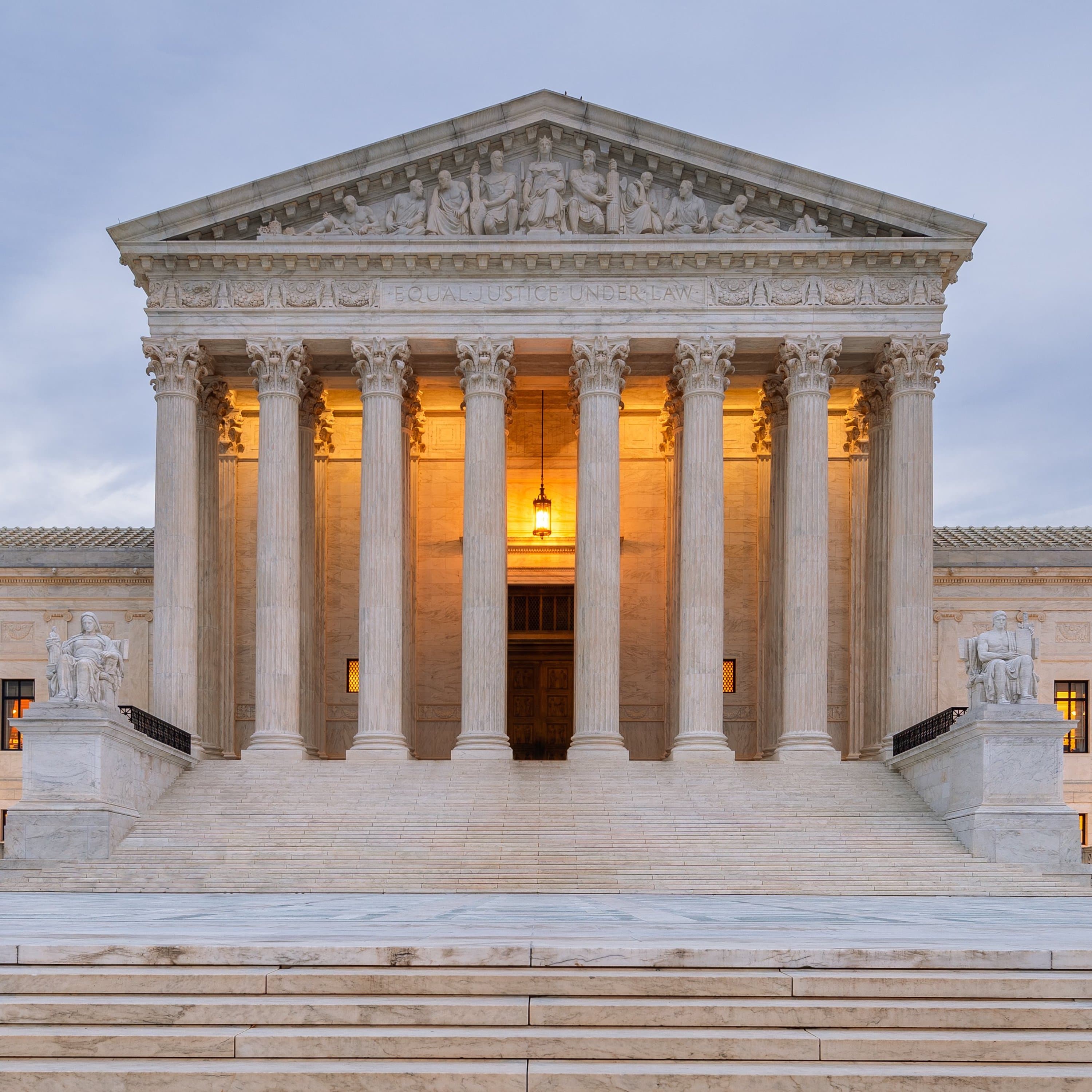
Supreme Court hears Jan. 6 case with implications for TrumpApple News Today · Apr 16, 2024
Main Topic: The Supreme Court's oral arguments on the case of former President Donald Trump's presidential immunity from criminal prosecution.
Key Points:
Participants:
Takeaways:
Implications:
Theme music fades out
John Bickley
This episode is brought to you by LifeLock. When you visit the doctor, you probably hand over your insurance, your ID, and contact details. It's just one of the many places that has your personal info. And if any of them accidentally expose it, you could be at risk for identity theft. LifeLock monitors millions of data points a second. If you become a victim, they'll fix it, guaranteed, or your money back. Save up to 40% your first year at LifeLock.com slash podcast. Terms apply.
Short pause
The Supreme Court heard oral arguments this week about one of the historic and consequential cases against former President Donald Trump. The case hinges on whether Trump has presidential immunity protecting him from key charges brought by Special Counsel Jack Smith. In this episode, we speak with a legal expert about what we learned from the court's questioning of both legal sides, what to expect in the coming months, and the implications of the case for Trump and future presidents.
Short pause
I'm Daily Wire Editor-in-Chief John Bickley. It's Sunday, April 28th, and this is an extra edition of Morning Wire. Joining us now to discuss Trump's presidential immunity case at the Supreme Court this week is Loyola law professor and legal commentator Jessica Levinson.
Jessica Levinson
Thanks for having me back.
John Bickley
So first, we had multiple hours of questions and answers for this case in the high court. What are your takeaways from what you heard in oral arguments Thursday?
Jessica Levinson
My big takeaway is that the Supreme Court is not going to say that there is absolute immunity from criminal prosecution for former presidents. And they're not going to say that there's no immunity. So we're going to see here that the Supreme Court is going to find some middle ground where if you are a former president and you face criminal charges, there's going to be some bucket of actions where you can't face those charges because you're immune and then there'll be this other bucket of actions where you can because all things being equal under the constitution we understand that the criminal justice system has to be able to move forward.
And if the court does does that mean they actually have to detail that to lay out what actions in the case fall under immunity in which do not? I think what you heard over more than two and a half hours of oral arguments is that the court does want to lay out some sort of test because this case isn't just about Donald Trump. Far from it. It's about every future president and whether or not they're subject to criminal prosecution and if they are, when.
And so I think the Supreme Court is going to give some sort of test for which acts are protected and which acts are not protected. And that's going to take them a while and they will probably then send this case back down to the trial court judge, Judge Chutkin. She will have to apply that new test. And if one of the parties doesn't like how she applies it, that could then be appealed back up to the D.C. Circuit, all of which is to say, even when the Supreme Court rules I don't think that the end of this case it means that the trial moves forward it probably means there a new test for the lower courts to apply.
So we looking at a complicated lengthy process in your view?
John Bickley
My suspicion is that we are looking at a lengthy process. I heard the justices really struggling with where to draw that line when it comes to immunity. And I think it's going to take them a while to hash out some sort of compromise where they can count to five votes for something approaching a standard.
Jessica Levinson
And I think it's going to take a bit of time for the trial court judge and maybe the court of appeals to apply that standard in the case pending before it, in the case involving the former president and election interference.
John Bickley
Special counsel Jack Smith obviously wants a tight timeline here. Do you then see this working out in Trump's favor in terms of delaying this process, stringing this process out?
Jessica Levinson
Absolutely. I think that this is a win for the former president, even if the Supreme Court doesn't adopt the legal position that he wants. We're looking at almost certainly a delay of the federal election interference trial pending against him past the next election. And that is really what he has wanted. He's wanted a delay. And again, no matter what happens, no matter what the specific test that the Supreme Court lays out is going to be, he will get that delay. And frankly, he already has.
John Bickley
When can we expect a ruling from the court? Is there a hard timeline for this or is it more amorphous than that?
Jessica Levinson
So the court almost always hands down that term's ruling by the end of June. Now, they added this case. This is the last day of oral arguments for the term. They're the Supreme Court. They could take longer if they want to, but I suspect that we're going to get a ruling somewhere in the last week of June.
John Bickley
And then as we've been talking about, it's for the lower courts to apply that ruling to this case involving the former president.
Jessica Levinson
So to be clear, the process that you're outlining here, which is the court detailing a more narrowly defined set of categories that qualify for immunity, that likely sets up an extended timeline for the trial.
John Bickley
If the court does actually side with one of the two arguments, can this process be sped up?
Jessica Levinson
There's certainly a way for the court to make a decision where they just send it right back down to Judge Chutkin. And if they adopted the former president's position, then you would dismiss all of the indictment that deals with official acts. There's still actually a lot of the indictment that deals with unofficial acts or private acts.
And one of what I read is one of the concessions from Trump's legal team was that there are really private acts here that are alleged in the criminal complaint. Then the question becomes, can you refer to official acts as part of the evidence to prove those private acts? Even if you can't have, and I know this sounds very detailed, but even if you can't have liability based on the official acts, can you use the evidence of the official acts to try and prove liability for, again, private acts?
And we can think of something like bribery where maybe you would have some sort of immunity for official acts but in order to show that you engage in bribery we need to show that you an elected official and that you, in fact, engage in an official act by saying, I'll take this money and now here's your Senate appointment. Right. So the action that you were bribe for was an official act that you took, but the fact that you took a bribe is still a criminal act.
Right. And what you heard is the justices really, frankly, trying to parse, as I view it, a couple of different thresholds. So is the question that if the thing alleged is an official act, then there's absolute immunity. Then the test becomes what's an official act? Or then the next thing that the justices struggled with was, well, maybe it should be more nuanced than just official acts. Maybe what we should look at is the core functions of the president, the things that in the Constitution only the president can do.
So what do we mean by that? The power to pardon, the power to recognize foreign nations, appointment powers. maybe those are the things where we can all agree there's immunity. And then there's some question about things kind of to the side of that. And then there was a lengthy discussion about if you can, in fact, prosecute a former president under a congressional statute, does the statute specifically have to say, and this applies to the president? that would obviously mean, if the answer is yes, that would obviously mean that there's really quite narrow circumstances, very, very narrow circumstances where you could criminally prosecute a former president.
John Bickley
In terms of the arguments from both sides, what was the strongest argument from Team Trump and what was the strongest argument from the federal government?
Jessica Levinson
So I think the strongest argument from Team Trump is that we do treat presidents as different from other people in a whole host of circumstances. And we all kind of acknowledge that. For instance, there's case law dealing with former President Nixon that says in the civil arena, not when it comes to criminal cases, but when it comes to civil cases, there's absolute immunity from official acts.
And when it came to the government, I thought they were on the strongest footing when they really pointed to the structure of the Constitution, the specific words, the text of the Constitution, which nowhere says that presidents enjoy absolute immunity or even qualified immunity.
And when they pointed to the consequence of what would happen if we said that, in fact, a president could assassinate a political opponent and make a ruling that that would be immune from criminal prosecution. I thought those were the highlights.
John Bickley
Now, again, most of the arguments for me were really in the details of where do they draw the line. I think the justices really were rejecting the more extreme positions of both sides and struggling with how do we figure out when you can make a former president a criminal defendant and when we have to say there just something different about former presidents and they should not be subject to criminal laws frankly like the rest of us
Jessica Levinson
As you noted we had a lengthy session in front of the court this week on this. Were there any surprises for you on Thursday?
John Bickley
So I don't know if it's a surprise, but as somebody who teaches constitutional law, I really heard all of the justices trying to figure out how we balance these competing interests, how we decide when a former president should enjoy immunity from criminal prosecution, and when the harms of immunity are greater than the harms of saying you can prosecute a former president.
Jessica Levinson
And what I heard was, I think, a division when it comes to the ideological makeup of the court. I really heard a division about consequences, where I heard the more conservative justices being worried about subjecting former presidents to criminal prosecution.
And I heard the more liberal justices worried about a set of laws where we say somebody is in fact above the law and or that a former president is subject to criminal prosecution only in very, very narrow circumstances.
There were some very detailed aspects of the oral arguments where I didn't expect them to spend as much time as they did. But that was one of my big takeaways is that there's a very different lens here when it comes to what the justices are most worried about when it comes to the impact of their ruling.
John Bickley
Broadening out a little bit here, how could this ruling impact other federal criminal charges against Trump?
Jessica Levinson
So that's a great question. And as I see it, the Mar-a-Lago case, which is the only other federal case pending against the former president really deals with acts that he took after he was in office. And so I don't see this case as directly affecting that case.
We could see this question of immunity affecting the Georgia state case because that case has a lot of overlap and a lot of commonality with the federal election interference case.
John Bickley
To put a button on this final question. I know this is a complicated case with lots of moving parts, so many of them hinging on the Supreme Court ruling, but where do you feel this is going in terms of the overall ruling and timing?
Jessica Levinson
So I think we will see a decision that's going to take some time, longer than it took the justices to come out with their decision about the Insurrection Act. So I think we're looking at a ruling that could come out in the end of June, maybe even the first week of July.
I think we're looking at the Supreme Court creating a standard for when former presidents can be subject to criminal liability and when they can't. And then I think what we're looking at is for the trial court judge and then possibly for that ruling to be appealed up to the D.C. Circuit, the Court of Appeals in this case, applying that new standard, all of which spells out a very welcome delay for the former president.
John Bickley
Well, Jessica, thank you so much for coming on and lending us your expert analysis.
Jessica Levinson
That was Loyola law professor Jessica Levinson, and this has been an extra edition of Morning Wire.
Theme music starts playing
John Bickley
Thanks for listening to this special episode of Morning Wire.

