--:-- Michael Simon Johnson: From the New York Times, it's the headlines. I'm Michael Simon Johnson. Today's Wednesday, June 18th.
--:-- Michael Simon Johnson: Here's what we're covering. As the conflict between Israel and Iran continues into its sixth day, President Trump has taken a newly combative tone, calling for Iran's unconditional surrender and threatening its supreme leader, writing on social media, "our patience is wearing thin."
--:-- Michael Simon Johnson: The comments came before Trump met with his national security team on Tuesday, and it's the latest signal that the U.S. may be considering joining Israel's bombing campaign against Iran.
--:-- Michael Simon Johnson: Should the U.S. join the fight, intelligence officials told The Times that Iran has prepared missiles for strikes on U.S. bases in the Middle East. In anticipation of that, the Pentagon sent three dozen refueling aircraft to Europe, where they can assist fighter jets protecting those bases.
--:-- Michael Simon Johnson: The most immediate decision for Trump is whether to deploy America's largest conventional weapon, a 30,000-pound bomb called the Massive Ordnance Penetrator. Israel has neither the bomb nor the planes heavy enough to carry it.
--:-- Michael Simon Johnson: Instead, it hopes the U.S. can use it to destroy Iran's most heavily fortified nuclear enrichment site, which is buried under a mountain. Trump has resisted helping Israel attack the facility.
--:-- Michael Simon Johnson: He pledged not to bring the U.S. into new wars and has largely pushed for a diplomatic solution in Iran. But that may be changing.
--:-- Michael Simon Johnson: He's basically got a choice between going back to the Iranians one more time and saying we made you an offer that would require you to give up all of your nuclear enrichment on Iranian soil, but over time.
--:-- Michael Simon Johnson: Or you can ignore the offer, as the Iranians have so far, and he'll say, I'll conduct this military operation. This is called coercive diplomacy.
--:-- Michael Simon Johnson: And I think he may take some time, but not very much time, maybe 24 hours, to give them that last chance. And then I suspect if they turn that down, he will make his move.
--:-- Michael Simon Johnson: Now, the Iranian system is so dispersed in terms of power between the generals, the ayatollahs, civilian groups, that I don't think they capable of making that decision in a day or a week or a month.
--:-- Michael Simon Johnson: So my sense is we kind of know where this may be headed. I think the president hopes here is you go, you drop your 30 bombs, you've made your point, and you go home.
--:-- Michael Simon Johnson: But the fact of the matter is the world is rarely that simple. The Iranians will have their moment to respond.
--:-- Michael Simon Johnson: It may be against American bases or troops in the Middle East. If any of them are killed, obviously the pressure would be on for a big escalation of the conflict.
--:-- Michael Simon Johnson: And it would put him in exactly the place where he said he did not want to be.
--:-- Michael Simon Johnson: For more on Trump's evolution on Iran, listen to White House reporter Jonathan Swan on today's episode of The Daily.
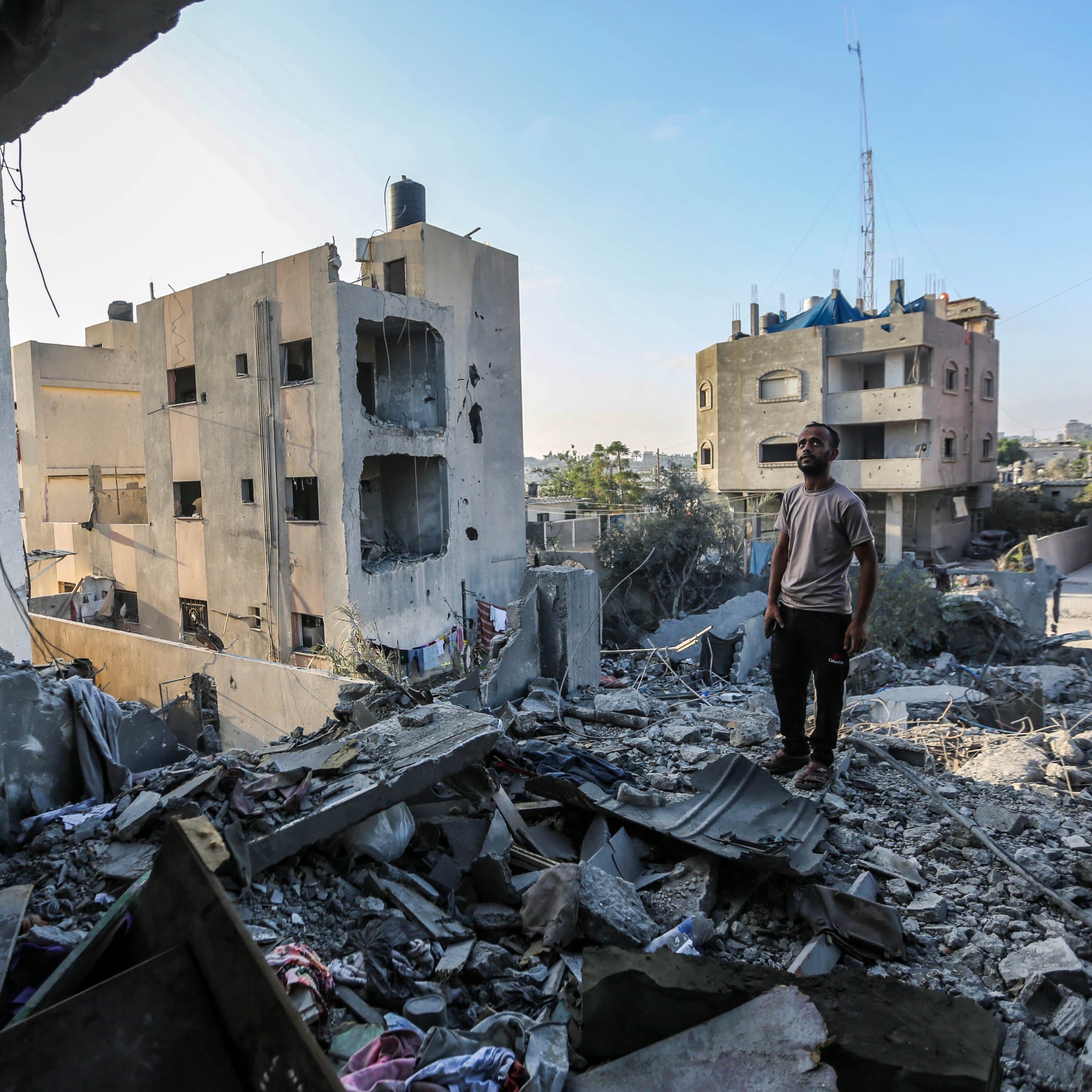
--:-- Michael Simon Johnson: Meanwhile, in Gaza, dozens of Palestinians have been killed and hundreds wounded this week near aid distribution sites, according to the local health ministry.
--:-- Michael Simon Johnson: Gaza officials blame Israel for the deaths, and the Israeli military says it's looking into the matter.
--:-- Michael Simon Johnson: In recent weeks, Israeli soldiers have repeatedly used deadly force to control crowds who they say are rushing aid trucks.
--:-- Michael Simon Johnson: This has forced many Gazans to make a choice. Let their families go hungry or risk getting shot.
--:-- Michael Simon Johnson: Some Palestinians have told The Times they now won't go back. One said, "the danger is too high for me. I don't want to face death this way."
--:-- Michael Simon Johnson: In Ukraine, the war there carries on, as Russia pummeled Ukraine's capital, Kiev, with drones and missiles on Tuesday.
--:-- Michael Simon Johnson: It was the deadliest attack in nearly a year, killing 10 people, including a U.S. citizen, and wounding at least 100 more.
--:-- Michael Simon Johnson: Russia has been intensifying its airstrikes against Ukraine in the last few weeks, launching as many drones and missiles in a single night as it did throughout all of June last year.
--:-- Michael Simon Johnson: The latest attack comes as Ukraine's President Volodymyr Zelensky traveled to Canada to meet with G7 leaders and pushed them to hit Russia with tougher sanctions.
--:-- Michael Simon Johnson: But during the summit, President Trump seemed to blame the war on the G7, criticizing the group for expelling Russia over a decade ago after it annexed Crimea.
--:-- Michael Simon Johnson: Trump said, "they should let Russia come back in because we should have Russia at the negotiating table."
--:-- Michael Simon Johnson: Ultimately, Trump rejected the idea of G7 leaders releasing a joint statement supporting Ukraine and he left the summit before he was scheduled to meet with Zelensky.
--:-- Michael Simon Johnson: We are seeing a dramatic increase in threats against senators, congressmen, public officials, and throughout America.
--:-- Michael Simon Johnson: In Washington, members of Congress from both parties are pushing for more security and more security funding in the wake of recent attacks in Minnesota against state lawmakers.
--:-- Michael Simon Johnson: Senators met on Tuesday with a top congressional security official who briefed them on new measures to deal with rising concerns of political violence.
--:-- Michael Simon Johnson: Last year, Capitol Police investigated more than 9,000 threats against lawmakers, their families, and staff, a significant increase from the previous year.
--:-- Michael Simon Johnson: However, of those thousands of threats, prosecutors secured only eight convictions.
--:-- Michael Simon Johnson: In the medical world, an unconventional idea, one that's promised to upend our understanding of Alzheimer's, has been spreading.
--:-- Michael Simon Johnson: It's the focus of television specials, popular podcasts, conferences, self-help books. The idea is that lifestyle changes and supplements can not only slow the progression of Alzheimer's, but actually reverse it.
--:-- Michael Simon Johnson: The Times spoke with doctors and researchers who study the disease, and they say these big claims have little proof backing them up.
--:-- Michael Simon Johnson: I've been reporting on a man whose claims about his program have been infuriating the medical establishment.
--:-- Michael Simon Johnson: Lindsay Gelman covers health and has been following a former neurologist at the forefront of this movement, a man named Dale Bredesen.
--:-- Michael Simon Johnson: His books on Alzheimer's have sold hundreds of thousands of copies, and his program has trained more than 2,000 health practitioners and reached thousands more patients.
--:-- Michael Simon Johnson: Over eight months, Lindsay followed one couple as the wife, Carrie Briggs, went through Bredesen's intensive and expensive program.
--:-- Michael Simon Johnson: They started last July with a whole regimen of supplements. It worked its way up to being about 34 different supplements a day that Carrie was taking.
--:-- Michael Simon Johnson: And after trying all of these different elements of the program, the diet, the hormonal treatments, the visits, the supplements, all together, that cost around $25,000.
--:-- Michael Simon Johnson: And they were hoping to see some sort of improvement in her symptoms, but that just wasn't happening.
--:-- Michael Simon Johnson: If you improve your exercise and diet so that your cardiovascular health improves, you can potentially, according to medical experts, slow down the progression of Alzheimer's symptoms.
--:-- Michael Simon Johnson: But the experts I spoke to say that's really different than the claim of reversing the underlying physiology of Alzheimer's disease.
--:-- Michael Simon Johnson: And that claim is not supported by the small number of studies that Bredesen has done.
--:-- Michael Simon Johnson: There is no cure for Alzheimer's disease, and 7 million Americans have it, which means that's a really large population of patients that are looking for some sort of answer.
--:-- Michael Simon Johnson: And when you combine that with the idea that a program is being marketed to patients and their loved ones, experts say that you risk offering that vulnerable patient population false hope.
--:-- Michael Simon Johnson: And finally, everyone's going to say, well, they're just cheerleaders. Well, we're really good cheerleaders.
--:-- Michael Simon Johnson: The new season of Netflix's hit show America's Sweethearts about the Dallas Cowboys cheerleaders premiered today, and it addresses an issue that's plagued the organization for years: how much the cheerleaders get paid.
--:-- Michael Simon Johnson: A former Cowboys cheerleader sued the team in 2018 over unfair pay, claiming she was paid about $7 an hour with no overtime, plus a $200 per game fee.
--:-- Michael Simon Johnson: In total, that was less than what the team mascot made.
--:-- Michael Simon Johnson: But, and spoiler alert, if you plan on watching, Netflix's docuseries reveals that the women, who often work long hours while juggling other jobs or college, are now getting a roughly 400% pay raise for the 2025 season.
--:-- Michael Simon Johnson: The numbers are still vague. The show doesn't say exactly how much they're making or what they made before.
--:-- Michael Simon Johnson: The Times spoke to two Cowboys cheerleaders who were part of this push for higher wages, who said, under this new agreement, veteran cheerleaders could be making around $75 an hour, though they still won't get health insurance.
--:-- Michael Simon Johnson: Still, one expert said the pay increase won't just benefit Cowboys cheerleaders, but will raise the overall market rate for cheerleaders across the board.
--:-- Michael Simon Johnson: Said one of the cheerleaders, "we're hardworking athletes who deserve to be seen as such."
--:-- Michael Simon Johnson: Those are the headlines. I'm Michael Simon Johnson. We'll be back tomorrow.