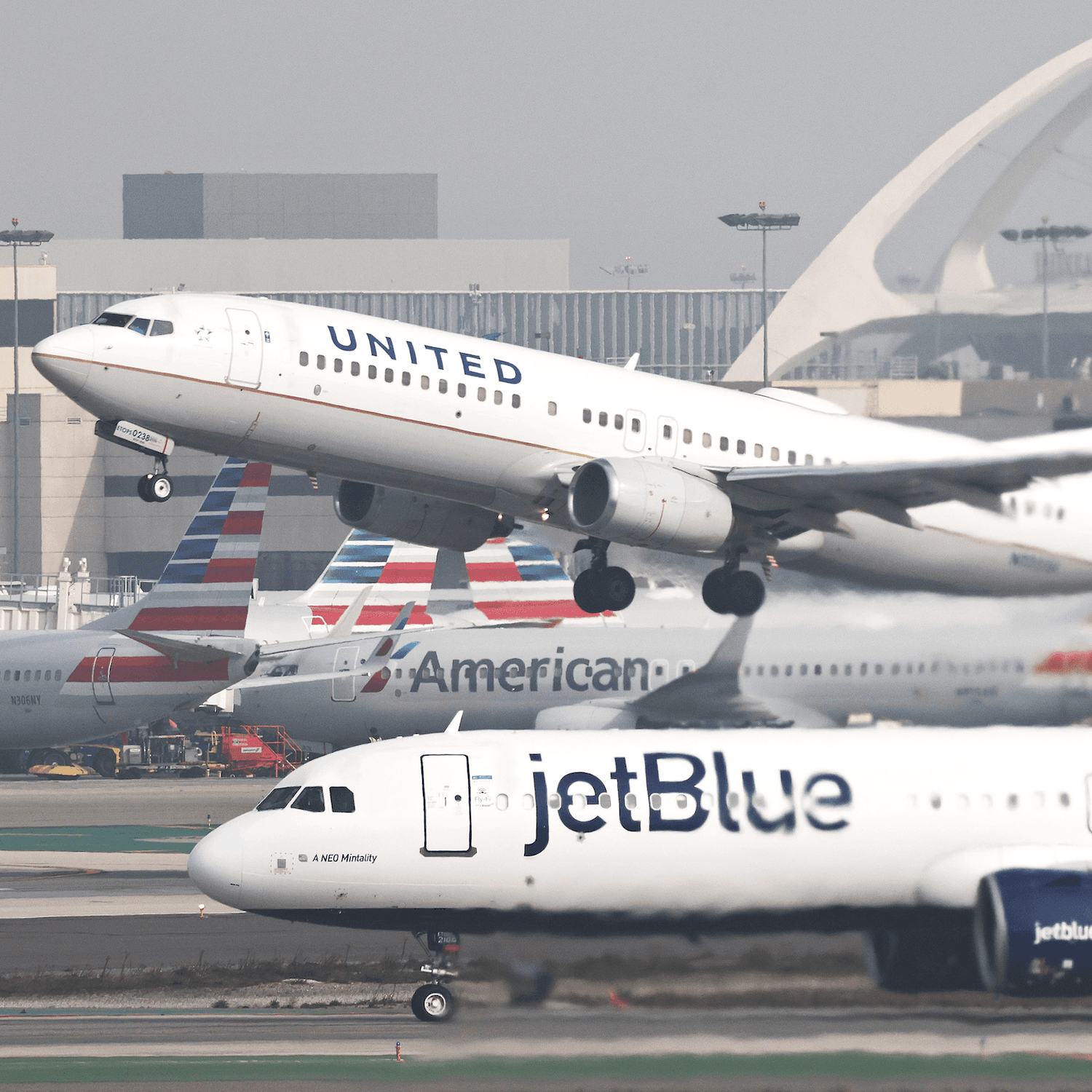
--:-- Sean Rameswaram: First, there was the one over D.C. Shocking, tragic, the president blamed D.E.I. Yikes. But then they kept coming. There was that medevac flight that crashed in the middle of Philadelphia. There was a deadly crash on an ice flow in Alaska. There was the Delta flight that landed upside down at Pearson in Toronto. And then on Tuesday, while we were in a meeting talking about doing this very show, we heard a Southwest flight almost hit a private jet at Midway in Chicago that same day. The same thing, more or less, happened back at DCA. The same airport where that helicopter crashed into a commercial flight, killing 67 people back in January. On Today Explained, we're asking the question we've all been asking. Should I really get on a plane right now? Should we just drive instead? Is it still safe to fly? What is going on with the planes? I really like landing right side up. Is that weird?
--:-- [Support for Today Explained comes from Saks Fifth Avenue]
--:-- Sean Rameswaram: Support for Today Explained comes from Saks Fifth Avenue. Fall is here. Might be time to find some nice new pieces you can wear again and again. With Saks Fifth Avenue, it can be a breeze to shop for your personal style, like maybe a relaxed Prada blazer or Gucci loafers that are great for both work and the weekend. This is very Sean. This is very Sean-coated. Gucci loafers. Saks says Saks makes shopping feel totally customized to you, whether that's from an in-store stylist or a visit to Saks.com, where they can show you just what you want to see. They say they'll even let you know when arrivals from your favorite designers are in or when something you've been eyeing is back in stock. You can find inspiration for your personal style every day at Saks Fifth Avenue.
--:-- Sean Rameswaram: Support for this show comes from Strawberry.me. Be honest. Are you happy with your job? Or are you stuck in one you've outgrown? Or never wanted in the first place? Sure, you can probably list the reasons for staying, But are they actually just excuses for not leaving? Let a career coach from strawberry.me help you get unstuck. Discover the benefits of having a dedicated career coach in your corner. Go to strawberry.me slash unstuck to claim a special offer.
--:-- Sean Rameswaram: Ladies and gentlemen, this is your captain speaking. Welcome aboard Today Explained. Sean Rameswaram for him here with Daryl Campbell, who writes about aviation for The Verge.
--:-- Daryl Campbell: I know it's been a little bit terrifying, to be honest, especially over the last 12 weeks. I think this has been the most crashes that we've seen since, I think, before the pandemic. And so when you see that, it's obviously really newsworthy. And it's something that strikes a lot of fear into people's hearts.
--:-- Daryl Campbell: The good news is the airplanes right now are fine. Commercial aviation remains one of the safest modes of transportation. But it does show that in order to be safe, we need to have every single part of this very complex system working in sync. And I think there's signs that some of it is starting to show a little bit of stress.
--:-- Daryl Campbell: And because of that, more people than perhaps I've heard since maybe 9-11 in my personal life have said, I'm second guessing flying this year. Yeah. And I wouldn't blame anybody for, you know, pulling up the Amtrak website the next time that they decide that they need to take a trip.
--:-- Sean Rameswaram: I mean, if you think about it, we've had two major crashes of a commercial airplane in North America. A regional plane has collided with a Black Hawk helicopter. There is an active surge happening in the Potomac River. You're looking at live images from Toronto's Pearson Airport. The jet appears to have flipped upside down.
--:-- Daryl Campbell: We've had two in Asia. And then you've got this sort of ambient background of there's the air ambulance crash in Philadelphia. That's where a medical transport plane smashed into the ground and caused a massive explosion. The crash killed seven people and injured 19 others.
--:-- Daryl Campbell: And there's the planes that collided on the runway in Scottsdale. We've learned a jet veered off the runway after landing and crashed into a business jet. Another pair that collided in midair near Tempe. In fact, just before this, there was a Southwest Airlines airplane that's basically involved in what's called a runway incursion, where they were trying to land and another airplane was crossing in front of them.
--:-- Daryl Campbell: The FAA says that jet entered the runway without authorization. People are primed to look at this sort of thing right now, and especially because over the last couple of years, ironically, in a bid to improve safety, every single airport has a lot of recording devices, video cameras, and so we can get video of a lot of these things happening.
--:-- Daryl Campbell: So it makes it a little bit more vivid. But statistically speaking, it's safer now to fly than it has been at any point since the 1960s. And even if you take the last couple of years, it's safer now to fly than it was even before the pandemic.
--:-- Daryl Campbell: And so even though it feels like certain things are breaking down, other things are also going right to make sure that even if in the worst case scenario, people are still able to to exit the airplane without anything, without any injury or anything like that.
--:-- Sean Rameswaram: I mean, you made a passing reference about checking Amtrak rates, but more likely, I think in this country especially, people are going to drive instead. You are making the argument that it's still safe to get on a plane. Help me understand it in maybe comparison to driving.
--:-- Daryl Campbell: Even with all of these incidents we've seen in the past month or so in the United States and abroad, how much safer is it right now to fly than to drive?
--:-- Daryl Campbell: So your chance of getting into a fatal car crash at some point in your life is a little bit less than one in a hundred. So it's like one in 95 or so. It's about a 1% chance.
--:-- Daryl Campbell: Okay. But the thing about that is people are in control when they get in the driver's seat. They feel like they're the best driver on the road, that they can sort of maneuver their way around an accident, that they can deal with whatever.
--:-- Daryl Campbell: Whereas when you're in the back of an airplane, you're not in charge. You're in the middle of this complex system that maybe you understand, maybe you don't.
--:-- Daryl Campbell: And, you know, you've seen Lost. My husband keeps reminding me that planes want to be in the air. You've seen flight with Denzel Washington. You've seen all of these horrible things that make you fear the worst whenever you feel the slightest bump.
--:-- Daryl Campbell: So that's kind of the psychological background. But statistically speaking you could fly twice a day for about 2 years before you even run the risk of getting into a fatal aviation accident So that is I think it like 10 orders of magnitude safer than just getting in your car every day
--:-- Daryl Campbell: But that's not how the human mind works. The human mind fixates on the stuff that you dread and the stuff that you feel like you have no control over.
--:-- Daryl Campbell: So it's totally understandable, and I totally get it. The human mind is also, I've seen it all over social media, making a connection here. Joe Biden is president for four years. Pete Buttigieg is in charge of transportation. Planes seem to mostly work. Donald Trump takes over, puts a Fox News host in charge of transportation. Elon Musk starts cutting jobs and all of a sudden planes are crashing.
--:-- Daryl Campbell: Is there a there there? Yes, but not for the reasons that people think.
--:-- Daryl Campbell: So the one of the things to understand about aviation is like in the 1950s and the 1960s, airplanes would crash for reasons that now seem like boneheaded things, like they didn't really understand how to make them properly, or people didn't know how to, you know, tell the pilot that he's screwing up or anything like that.
--:-- Daryl Campbell: And so we've actually ironed out most of the big, obvious hazards in aviation. So paradoxically, when something happens now, it's because a lot of individual things happened, each of which reduced the margin of safety just by a little bit, but then enough of them added up so that it actually caused a disaster.
--:-- Daryl Campbell: In the context of the American Airlines mid-air collision outside of D.C., we had a last-minute runway change. We had a pilot on the helicopter who was on what's called a checkride, so she was essentially getting tested on her abilities.
--:-- Daryl Campbell: We had a simultaneous radio transmission where the helicopter pilots didn't hear an important piece of information from air traffic control. And then we know that they were looking at what was probably a different airplane than the one they were tracking.
--:-- Daryl Campbell: So again, each one of those things wouldn't have caused an accident by itself, but all of them happened simultaneously. And then also against the background of air traffic control being understaffed and really overworked, especially at Reagan Airport, it just made all of these things line up in such a way that sort of catastrophe followed.
--:-- Sean Rameswaram: Okay, but you're saying that in the most tragic of all of these accidents, the one that's truly a tragedy here, you know, no disrespect to the plane that flipped over in Toronto, which was certainly scary, there were a host of reasons that plane crashed.
--:-- Daryl Campbell: Some of them were things that people had pointed out in the past that were just not dealt with. Some of them were, you know, like maybe a blind spot that couldn't be helped, whatever it was.
--:-- Daryl Campbell: Like, how do you fix a problem that is so multifaceted? And how do you do it quickly so it never happens again?
--:-- Daryl Campbell: There's, I think, a couple of things that the aviation system already does that address that. So a lot of it is like, if you remember the movie Sully with Tom Hanks.
--:-- Daryl Campbell: No one has ever trained for an incident like that. No one. And the whole frame of the movie is that they're in that hearing and they're just asking a lot of these really specific questions.
--:-- Daryl Campbell: Our job is to investigate how a plane ended up in the Hudson River. On the Hudson River. Well, that actually happens every time that there's an incident. And so we'll get to the bottom of this in probably between sort of six months to a year's time.
--:-- Daryl Campbell: But there's really not a ton of quick fixes. And I think probably the most tragic thing in the American Airlines accident above Reagan is that all of those problems that we talked about, understaffing at the air traffic control center, last minute deviations in sort of a flight path at the last minute in one of the most congested airports in the entire country.
--:-- Daryl Campbell: The fact that there's a military base just a couple miles where helicopters are taking off and landing. All of these things are big systemic problems. And as anybody who's worked in a big organization knows, there's just a lot of inertia that you have to get over in order to fix these things.
--:-- Sean Rameswaram: So does that mean that, you know, there's this sense that after a tragedy like this, the one that happened over DCA, that, oh, maybe it's now safer to fly, though, because everyone's going to be on their best behavior.
--:-- Daryl Campbell: Everyone's going to be looking out for problems. But you're saying the problems here are going to take a while to fix.
--:-- Daryl Campbell: Does that mean that things didn't even get that much safer after what happened over DCA and in the intervening month?
--:-- Daryl Campbell: There's really only one way to ensure that there are no plane crashes anywhere in the world, and that's just to ground every single airplane.
--:-- Daryl Campbell: As long as you have people flying airplanes, there will be problems that can put people's lives in danger.
--:-- Daryl Campbell: You should worry about airplanes when they start to crash for the same reason. You think about the two, for example, Boeing 737 MAXs that crashed in 2018 and 2019.
--:-- Daryl Campbell: They crashed for the same reason that Boeing had put in this faulty piece of software that could essentially overpower pilots and rip controls away from them and cause a crash. And then they tried to cover it up right afterwards.
--:-- Daryl Campbell: And that's the sort of thing that you really need to worry about.
--:-- Daryl Campbell: I think the best consolation is that we've gotten to the point where the risk of a fatal plane crash is less than one in two million.
--:-- Daryl Campbell: So I'm comfortable accepting that. The safest thing for you to do is just sit in your room and not do anything all day.
--:-- Daryl Campbell: I think all of us want to go places, do things, and sometimes you just have to accept a little bit of risk.
--:-- Daryl Campbell: Fortunately, air travel is one of the least risky things that you can do.
--:-- Daryl Campbell: Every man dies, but not every man really lives. That's right. Some of them are just on Twitter all day.
--:-- Sean Rameswaram: Daryl Campbell, he's got a book coming out in April. It's called Fatal Abstraction, Why the Managerial Class Loses Control of Software.
--:-- Daryl Campbell: He'll be in South by Southwest in Austin to promote it on March 8th at 11.30 a.m.
--:-- Sean Rameswaram: And I'll be at South by Southwest in Austin to promote Rami Youssef on the exact same day at the exact same time so you can choose between us.
--:-- Sean Rameswaram: This is your pilot speaking when we're back on Today Explained.
--:-- Sean Rameswaram: Support for Today Explained comes from Built Rewards.
--:-- Sean Rameswaram: These days, it seems like everybody has a rewards program. You swipe your card and you get one cent on the hundred dollars. But with your rent, frequently, you just pay month after month. You never get anything from it other than that roof over your head. Not anymore, says Built Rewards.
--:-- Sean Rameswaram: Built Rewards says it lets you earn points on your rent By paying rent through Built they say you can earn flexible points that can be redeemed toward hundreds of hotels and airlines perhaps a future rent payment your next Lyft ride and so much more
--:-- Sean Rameswaram: Your home isn just where you sleep it's your community, and Bilt wants you to go out and do things in the community. You can eat at your favorite local restaurants, then earn more points. You can get VIP treatment at certain fitness studios. You can enjoy exclusive experiences just for Bilt members every month.
--:-- Sean Rameswaram: When you're ready to travel, they say Built Points can be converted to miles or hotel points all around the world. You can earn points on rent and around your neighborhood wherever you call home by joining Built.com slash Explained.
--:-- Sean Rameswaram: That's J-O-I-N-B-I-L-T dot com slash Explained.
--:-- Sean Rameswaram: Why shop at Burlington? Maybe it's the deals that are new each time you drop by. Maybe it's the brand names you'll be shocked Burlington has in store. Or maybe it's the quality of the items, the amazing selection and the newest trends.
--:-- Sean Rameswaram: If you like to save but also like to stay in style, Burlington is your answer. And the question you'll be asking yourself is why go anywhere else? Burlington. Deals. Brands. Wow.
--:-- Sean Rameswaram: Support for the show today comes from Life Kit, the podcast from NPR.
--:-- Sean Rameswaram: What's in your life kit? I'm asking. They didn't ask that.
--:-- Sean Rameswaram: Every day you have to make choices that might shape the direction of your life, but you can't flip to the back of the book to find an answer key. Instead, you can listen to the Life Kit podcast from NPR.
--:-- Sean Rameswaram: Life Kit offers real stories about common issues like relationships, finances, parenting, and your career. If you're looking to move with more intention or just need thoughtful guidance on living better, Life Kit delivers strategies to help you make meaningful, sustainable change.
--:-- Sean Rameswaram: From fitness routines to mental resilience, navigating personal goals to tackling burnout, each episode is full of relevant insights and clear takeaways about things we all could use a little help with.
--:-- Sean Rameswaram: LifeKit wants to help you approach your own life with confidence and clarity and walk away with a game plan you can implement right away.
--:-- Sean Rameswaram: Enough from me. Go listen to the show LifeKit. It's a podcast from NPR.
--:-- Sean Rameswaram: Ladies and gentlemen, we have begun our descent of flight today explained. Please prepare for landing.
--:-- Sean Rameswaram: You ever see Up in the Air 2009? In it, George Clooney is obsessed with status, airline status specifically. I don't spend a nickel if I can help it unless it somehow profits my mileage account. So what are you saving up for, Hawaii? South of France? It's not like that. The miles are the goal.
--:-- Sean Rameswaram: Clooney's got a target, 10 million miles. If he gets there, he gets to meet the chief executive pilot, and he gets there. You're the youngest yet to hit 10 mil. Don't know where you found the time. We really appreciate your loyalty.
--:-- Sean Rameswaram: The chief executive pilot is played by Sam Elliott, big gray mustache, southern drawl. Captain John Cox is basically that pilot, but in real life.
--:-- Captain John Cox: I'm John Cox. I'm the CEO of Safety Operating System, an aviation safety consulting firm. And you also have some experience in our skies.
--:-- Captain John Cox: I've been a pilot for 55 years. I flew for one of the airlines for 25 of those. For 23 of the 25, I was a captain.
--:-- Captain John Cox: When you're at 10,000 feet and it's time to land, take us through that process.
--:-- Captain John Cox: The process really starts hundreds of miles earlier, and that's when you're starting preparing the flight computers and everything, as well as the pilots to say, all right, we're going to land at Los Angeles. We're going to probably land on this runway. We're probably going to get this instrument approach.
--:-- Captain John Cox: All of those things, those briefings are done in advance. And as you come down, you also want to prepare the cabin for arrival. So this is when you hear the PA announcement that says, We're about 20-25 minutes out. Here's the weather.
--:-- Captain John Cox: This is keying the flight attendants that they have a limited amount of time to make sure that the cabin is prepared for landing. That continues until you get to about 10,000 feet.
--:-- Captain John Cox: There's a speed restriction below 10,000. So you slow the airplane down and this is also, you'll hear typically a chime noise and then the flight attendants will speak.
--:-- Captain John Cox: Hi folks, we are heading into our descent into Los Angeles. And then... Please make sure your seats are in the fully upright position and tray tables are stowed.
--:-- Captain John Cox: For us on the flight deck, things are beginning to pick up. More and more radio traffic, you're being sequenced at that point for the runway.
--:-- Captain John Cox: The descent, you're descending to a lower and lower altitude. And as you get close, they'll turn you to a line with the landing runway. There may or may not be traffic ahead of you that you're looking to follow.
--:-- Captain John Cox: You'll switch the autopilot off typically, get the airplane on the proper lateral and vertical guidance, and you come in and land the airplanes and then taxi to the gate.
--:-- Captain John Cox: I mean, I call it a symphony of motion because there's a lot of people you don't see in the background that are making every one of these flights go safely.
--:-- Captain John Cox: How much of what you just described involves the FAA?
--:-- Captain John Cox: Oh, virtually everything. The FAA is involved in the oversight and certification of the airplane, of the certification of the pilots, the flight attendants, the maintenance staff, the flight dispatchers, the air traffic controllers.
--:-- Captain John Cox: All of these key jobs interface with the FAA. The FAA as the regulator is a key component to aviation safety.
--:-- Captain John Cox: And now just as Americans, perhaps in greater numbers than we've seen in a decade or two, are feeling nervous about getting on a plane, are feeling less secure about the FAA, Doge has gone and eliminated something like 400 jobs from this agency.
--:-- Captain John Cox: Can you help us understand what some of the jobs that got the axe were?
--:-- Captain John Cox: They reduced the number of new hired maintainers of radio and radar equipment. And our system is an older system, and it requires a good bit of maintenance.
--:-- Captain John Cox: And so the biggest concern in the near term is that we going to have radios or things that fail and that will limit the air traffic controller in being able to accept more flights So the problems are going to show up It may not be today or tomorrow or in the short term, but the maintenance staff for our older radar and radio facilities throughout the country, they're going to be impacted.
--:-- Captain John Cox: Our transportation secretary, Sean Duffy, the new one, the guy from like the MTV reality TV shows. As we're sitting on the boat and hanging out and all of a sudden I see Montana like looking at me like she's going to unzip her vest and show me a boobie.
--:-- Captain John Cox: Has said that none of these jobs that were eliminated at FAA were terribly critical to safety. All the critical safety positions like air traffic controllers and inspectors, all of those positions have been protected. No one's been fired. Actually, we're hiring into those spaces.
--:-- Captain John Cox: And it sounds like you're agreeing with him. You, someone who has decades more experience than him in this world, agree.
--:-- Captain John Cox: Well, there is a definition for safety-critical jobs. Pilots, flight attendants, aircraft maintenance technicians, flight dispatchers, those are all designated as safety-critical jobs, and none of those were reduced.
--:-- Captain John Cox: Air traffic controllers, a safety critical job. None of those were reduced. The definition that was used of a safety critical job, it's true that the maintenance of the equipment that air traffic control uses, that was not considered to be a safety critical position.
--:-- Captain John Cox: In the short term, we have key and critical components that have been maintained to a given standard. If we don't have the number of maintainers, then not all of that maintenance is going to get done.
--:-- Captain John Cox: What it will affect in the longer term is the ability for air traffic control, as an example, to be able to take as many flights. If they have a radar outage or a radio outage in an area, traffic will have to be routed around that area.
--:-- Captain John Cox: Can it be done safely? Yes. Then will it impact capacity? Yes. And if you take it to the extreme, the capacity cutbacks could mean fewer flights that people have choices from and potentially even higher pricing.
--:-- Captain John Cox: But the reliability factor is more on the capacity side than the safety side.
--:-- Captain John Cox: We also at the same time have been hearing for years that air traffic control towers have struggled with staffing, that we're something like 2,000 air traffic controllers short, according to the FAA.
--:-- Captain John Cox: Why is that? Well, I think the job recruiting, getting the right candidates has been a real challenge. Being an air traffic controller is a very intense, highly trained position.
--:-- Captain John Cox: And to get through the training process and to become a full performance level controller takes years. Most air traffic controllers right now, or many of them, are working six days a week.
--:-- Captain John Cox: And if they put in for vacation time, they may or may not get it. And this doesn't happen once. It happens frequently. So the attraction of getting the highest qualified people when you have that sort of work-life balance issue becomes more difficult.
--:-- Captain John Cox: And part of it has been funding. And the issue with FAA funding goes back many decades. Billions in automatic spending cuts approved by Congress have prompted the Federal Aviation Administration to cut funding to staff air traffic control towers.
--:-- Captain John Cox: The first nationwide ground stoppage since 9-11 now traced to an FAA system failure undergoing routine maintenance. The FAA was merely under-resourced, which has been a continuing mantra.
--:-- Captain John Cox: The steady funding from Congress is critical to the FAA's not only operation, but its ability to recruit and hire. And one of those positions is air traffic control.
--:-- Captain John Cox: If we could take the political considerations out of it and provide a steady funding source saying that this is a critical function, very many of the FAA's problems would go away slowly.
--:-- Captain John Cox: We would be able to get and recruit air traffic controllers. We can update the equipment. All of this is going to take time. The root of this is steady congressional funding for the FAA.
--:-- Captain John Cox: Has anyone come to you in the past few weeks and said, you know, Captain, I'm really nervous about getting on a plane right now for the first time in my life, for the first time since 9-11?
--:-- Captain John Cox: I have. I've heard that, but as an example, I was coming back home and we were letting down into our home airport and there was a lady seated next to me.
--:-- Captain John Cox: She was much more worried about the fact that it was getting pretty bumpy and she was getting less and less comfortable to the point it was fear, but it was due to the turbulence.
--:-- Captain John Cox: And I talked to her and explained who I was and helped her get through that. So when you think of how many components come into a safe flight.
--:-- Captain John Cox: We've had a couple of bad events in the last few months. There's a heightened interest in the media, and consequently, there's a heightened reporting back into the public.
--:-- Captain John Cox: There is a disproportionate amount of concern, almost fear, but people will go get in a car recognizing that we're going to lose 44,000 people this year in automobile accidents, and somehow that's okay.
--:-- Captain John Cox: So when you balance this out, my biggest concern on any flight, as far as safety goes, is the drive to and from the airport.
--:-- Captain John Cox: Captain Cox, thank you so much for your time.
--:-- Captain John Cox: My pleasure.
--:-- Victoria Chamberlain: Amna Alsadi edited. Laura Bullard fact checked. And Patrick Boyd and Andrea Kristinsdottir mixed.
--:-- Victoria Chamberlain: Safe travels. Watch out for the cars. Thank you.