--:-- [Theme music fades out]
--:-- Jessica Mendoza: Welcome to The Journal, our show about money, business, and power. I'm Jessica Mendoza.
--:-- Ryan Knutson: [in the background, briefly] Hi, I'm Ryan Knutson.
--:-- Jessica Mendoza: It's Tuesday, November 12th. Today, we're discussing why abortion access won on Election Day, but didn't translate into votes for Democrats.
--:-- Laura Kusisto: [identified as a guest] One issue Vice President Kamala Harris leaned into was abortion rights. And when Congress passes a bill to restore reproductive freedom as President of the United States, I will proudly sign it into law.
--:-- Jessica Mendoza: Harris was a very articulate spokeswoman for these women who had not been able to get care for women who were sort of outraged at the rollback of their rights.
--:-- Laura Kusisto: That's our colleague Laura Casisto. She says that the Harris campaign hoped abortion rights would energize voters to come out and vote blue.
--:-- Jessica Mendoza: They spent big on ad buys across swing states, emphasizing why nationwide access to abortion should be restored.
--:-- Laura Kusisto: One of the ads, certainly one of the toughest ads that they had, was with a woman named Hadley Duvall in Kentucky.
--:-- Jessica Mendoza: And the ad opens and she is making breakfast for herself. And she tells this story about being sexually abused by her stepfather until she got pregnant at the age of 12.
--:-- Laura Kusisto: I didn't know what it meant to be pregnant at all. But I had options. Because Donald Trump overturned Roe v. Wade, Girls and women all over the country have lost the right to choose, even for rape or incest.
--:-- Jessica Mendoza: Donald Trump did this. He took away... Trump appointed three conservative justices who helped overturn Roe v. Wade.
--:-- Laura Kusisto: And for Harris, that was the message that they were really trying to get across, that whatever Trump might say now, he is responsible for the overturning of Roe and for these kinds of stories.
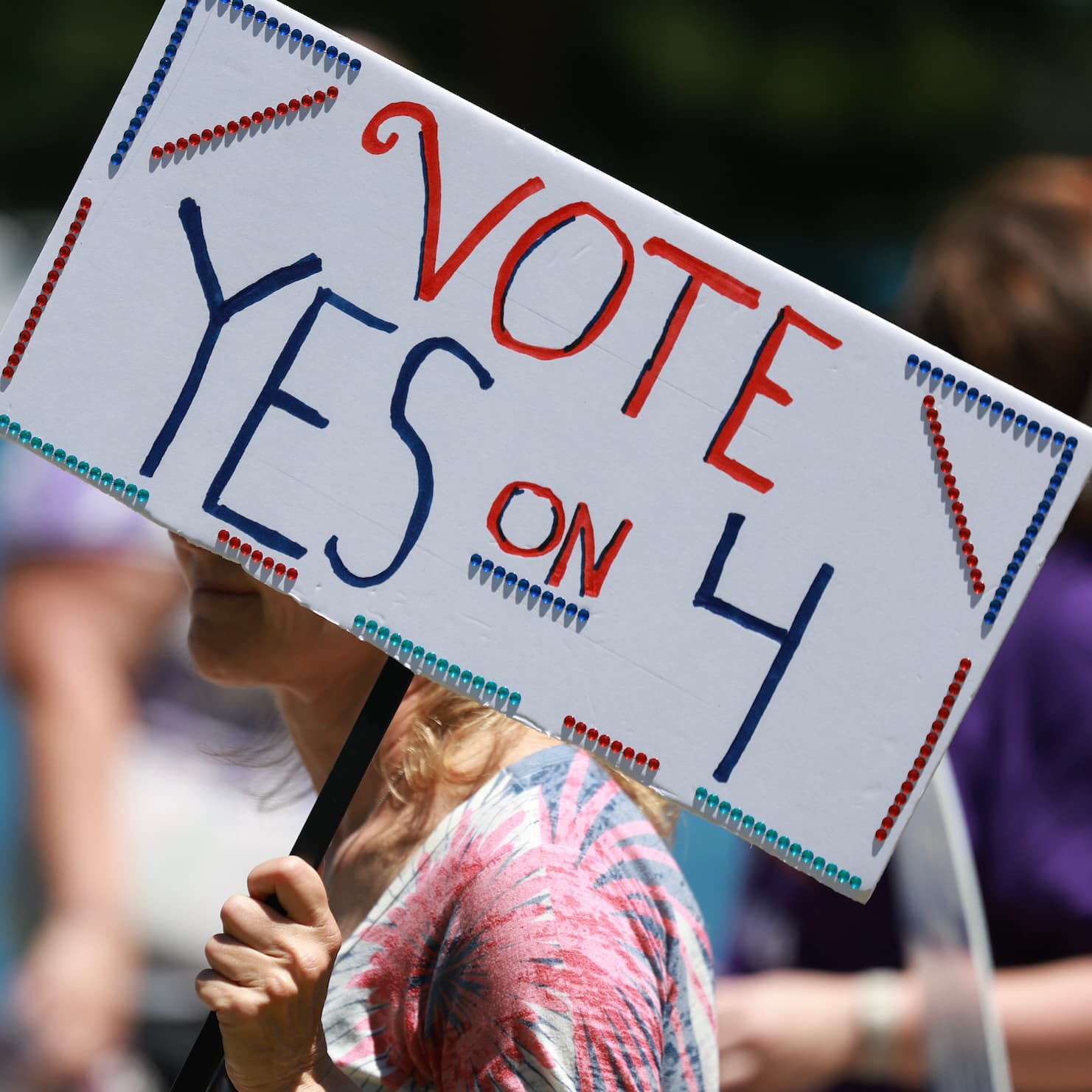
--:-- Jessica Mendoza: On Election Day, 10 states had abortion rights on the ballot. In seven of them, voters came out in favor of abortion access.
--:-- Laura Kusisto: But those votes didn't translate into votes for Harris.
--:-- Jessica Mendoza: One Democratic strategist talked about it as mind-boggling.
--:-- Laura Kusisto: And so I think we have to understand this as abortion rights, in essence, being more popular than Democrats right now.
--:-- Jessica Mendoza: Welcome to The Journal, our show about money, business, and power. I'm Jessica Mendoza.
--:-- Ryan Knutson: [in the background, briefly] Hi, I'm Ryan Knutson.
--:-- Jessica Mendoza: It's Tuesday, November 12th.
--:-- Laura Kusisto: It started two years ago. In a sweeping ruling that overturned a half a century of precedents, five justices ended the right of American women to choose abortion under the Constitution.
--:-- Jessica Mendoza: Roe v. Wade is overturned in June 2022, and the rollback of a constitutional right is unprecedented.
--:-- Laura Kusisto: And so no one really knows how the public is going to respond.
--:-- Jessica Mendoza: And I remember sitting in my office in August of 2022, about a month after this, and watching the results start to roll in from a ballot referendum in Kansas.
--:-- Laura Kusisto: And that referendum was about whether to eliminate abortion rights from the Kansas Constitution.
--:-- Jessica Mendoza: Kansas is considered a conservative state.
--:-- Laura Kusisto: And so there was an expectation that abortion rights would be restricted.
--:-- Jessica Mendoza: But when the votes came in almost 60 percent of Kansans voted to keep abortion protections in place.
--:-- Laura Kusisto: And I remember this feeling of being, to be honest, stunned by those results.
--:-- Jessica Mendoza: We were starting to see these results come in. And, you know, 57, 58, 59 percent of Kansans pushing back on this and, you know, expressing support for abortion rights for this ballot measure.
--:-- Laura Kusisto: And I wasn't the only one watching those results and taking that message away.
--:-- Jessica Mendoza: I have talked to anti-abortion leaders who say that this was a wake-up call for them, that abortion rights were much more popular than they had anticipated.
--:-- Laura Kusisto: And the 2022 midterms showed Kansas wasn't a fluke.
--:-- Jessica Mendoza: Ballot measures protecting abortion access passed in states across the country.
--:-- Laura Kusisto: Well, Michigan has now voted to protect abortion rights. 54% voted against new language, stripping any guarantee of abortion rights from Kentucky's constitution.
--:-- Jessica Mendoza: Vermont voters overwhelmingly passed a ballot measure to amend the state's constitution to explicitly protect abortion rights.
--:-- Laura Kusisto: The momentum went beyond ballot initiatives, boosting Democratic candidates throughout the country, too.
--:-- Jessica Mendoza: Democrats held control of the Senate and fended off much deeper losses in the House than many people had expected nationally.
--:-- Laura Kusisto: And so to be clear, the issue helped turn out voters for Democratic candidates in 2022.
--:-- Jessica Mendoza: Like, we can make that connection.
--:-- Laura Kusisto: Yeah, I mean, all evidence that we have is that it was a motivating factor for Democratic women to come out.
--:-- Jessica Mendoza: It also prompted independent and Republican women to switch and vote for Democratic candidates.
--:-- Laura Kusisto: And Trump himself, I should say, on social media said as much.
--:-- Jessica Mendoza: You know, he basically said, we are going to lose elections unless we figure out how to talk about this issue.
--:-- Laura Kusisto: Republicans are too extreme on this issue.
--:-- Jessica Mendoza: So there was a really kind of bipartisan consensus that this was good for Democrats in 2022.
--:-- Laura Kusisto: And I think the message, I know the message that Democrats took away is we have the winning issue in the country right now, the issue that speaks to people's hearts and emotions.
--:-- Jessica Mendoza: And it was kind of a galvanizing moment for Democrats.
--:-- Laura Kusisto: This is a big part of what the Harris campaign was relying on going into last week's election.
--:-- Jessica Mendoza: The hope was that having abortion on the ballot in so many places would drive turnout among voters who supported abortion rights.
--:-- Laura Kusisto: Democratic strategists assumed those voters would also support Harris.
--:-- Jessica Mendoza: As part of that strategy, Democrats adjusted their messaging around abortion.
--:-- Laura Kusisto: One of the messages that was really resonant in Kansas and that I think carried through campaigns after that was one about medical rights and medical privacy.
--:-- Jessica Mendoza: I think the American people believe that certain freedoms, in particular the freedom to make decisions about one's own body, should not be made by the government.
--:-- Laura Kusisto: It was very different than the way people had talked about abortion before.
--:-- Jessica Mendoza: They talked about it, they compared it to mask mandates and vaccine mandates and just talked about getting the government out of my business.
--:-- Laura Kusisto: And that was clearly resonant with sort of libertarian voters who might otherwise vote Republican, but for whom freedom was this really powerful issue.
--:-- Jessica Mendoza: While Harris framed herself as a champion of abortion rights, Trump took a different tack.
--:-- Laura Kusisto: He said that the question of abortion should be left up to the states.
--:-- Jessica Mendoza: There were strategists and anti-abortion groups who were really pushing him to say, you know, you should be out in front of it.
--:-- Laura Kusisto: You should have a position that you can sell to voters.
--:-- Jessica Mendoza: And Trump made this really kind of last-minute calculation that he was not going to do that.
--:-- Laura Kusisto: Instead, he was going to just say, I'm not going to take a position on this.
--:-- Jessica Mendoza: This is up to the states.
--:-- Laura Kusisto: And this, I think, made some of his own strategists nervous because it felt like he didn't have a kind of response to Harris on this issue.
--:-- Jessica Mendoza: But it turned out, by all accounts, to be a pretty winning strategy.
--:-- Laura Kusisto: It made it hard for Harris, I think, to persuade voters that their rights were under threat if Trump won the White House.
--:-- Jessica Mendoza: It made him just harder to pin down an attack on this issue.
--:-- Laura Kusisto: Trump's bet paid off with a wave of split tickets.
--:-- Jessica Mendoza: Voters who supported both abortion access and Trump.
--:-- Laura Kusisto: That's next.
--:-- Jessica Mendoza: Today, we helped a latte for Sam coffee shop get an insurance quote simply and easily and made sure a floral delivery van was able to make someone's day.
--:-- Laura Kusisto: We're the Hartford, with decades of experience insuring millions of unique small businesses.
--:-- Jessica Mendoza: When it comes to your small business insurance, one size absolutely does not fit all.
--:-- Laura Kusisto: Get a quote or find an agent today at thehartford.com slash smallbusiness.
--:-- Jessica Mendoza: Why shop at Burlington? Maybe it's the deals that are new each time you drop by.
--:-- Laura Kusisto: Maybe it's the brand names you'll be shocked Burlington has in store.
--:-- Jessica Mendoza: Or maybe it's the quality of the items, the amazing selection, and the newest trends.
--:-- Laura Kusisto: If you like to save but also like to stay in style, Burlington is your answer.
--:-- Jessica Mendoza: And the question you'll be asking yourself is, why go anywhere else?
--:-- Laura Kusisto: Burlington. Deals. Brands. Wow.
--:-- Jessica Mendoza: Of the 10 states that had abortion on the ballot last week, seven of them voted to protect it, including blue states like Colorado and New York, and also some red states like Missouri and Montana.
--:-- Laura Kusisto: Only three states voted not to protect the procedure, South Dakota, Nebraska, and Florida, which I say was kind of a special case.
--:-- Jessica Mendoza: On the one hand, 57 percent of voters voted in favor of the ballot measure in Florida.
--:-- Laura Kusisto: And that's in line with what we saw in other states.
--:-- Jessica Mendoza: But the tricky thing with Florida was it has a 60 percent threshold to pass a ballot measure.
--:-- Laura Kusisto: Very, very unusual.
--:-- Jessica Mendoza: So a majority of voters did support abortion rights, but they were still 3 percent short.
--:-- Laura Kusisto: Correct. Yes. Yeah.
--:-- Jessica Mendoza: So it came very close.
--:-- Laura Kusisto: Yes. Ballot measures also passed in Arizona and Nevada, two swing states where Harris was hoping to get a bump from turnout for abortion rights.
--:-- Jessica Mendoza: Instead, what you saw was a divergence where abortion rights won easily by more than 60% in both of those places, which is really quite remarkable.
--:-- Laura Kusisto: But Harris also lost.
--:-- Jessica Mendoza: And it ultimately didn't seem to move the needle in terms of getting them to vote for Democrats.
--:-- Laura Kusisto: So is it fair to say, like, a lot of Trump voters had to support these ballot measures, support abortion rights in order for these ballot measures to pass?
--:-- Jessica Mendoza: Yes, there is no other way to do that math.
--:-- Laura Kusisto: That is the only way to understand this is that a lot of people, millions of people voted for abortion rights and also for Donald Trump.
--:-- Jessica Mendoza: And you heard from some of these voters.
--:-- Laura Kusisto: So there's one voter we talked to in Missouri, a man named Aaron Turner, who's exactly that sort of type of voter.
--:-- Jessica Mendoza: He voted for Trump and he voted for abortion.
--:-- Laura Kusisto: And, you know, for him, abortion was a kind of freedoms issue, which is something we hear from a lot of more conservative voters.
--:-- Jessica Mendoza: There is some conflict in my mind regarding the abortion of a fetus, whether or not that's a child or not.
--:-- Laura Kusisto: I personally believe it is, but at the end of the day, I don't have the capacity or I believe the right to weigh in on every single decision.
--:-- Jessica Mendoza: And I also don't believe the government has the right to weigh in on that either.
--:-- Laura Kusisto: He just felt like, I don't want the government in this business.
--:-- Jessica Mendoza: This is an individual choice.
--:-- Laura Kusisto: So it almost sounds like the Harris campaign's messaging on abortion as an individual freedom worked.
--:-- Jessica Mendoza: It just didn't work for Harris.
--:-- Laura Kusisto: And so what do you make of this?
--:-- Jessica Mendoza: So I think two ways to think about this, two different categories of voters that I have in my mind.
--:-- Laura Kusisto: So one of them are voters who I talk to who say, yes, I support abortion rights.
--:-- Jessica Mendoza: If you ask me a straight up or down question about abortion, I'm going to say yes to abortion access.
--:-- Laura Kusisto: But it's not my number one issue.
--:-- Jessica Mendoza: And so even if I support this, Trump is talking about other issues that are more resonant to me, like immigration, like the economy, you name it.
--:-- Laura Kusisto: And then the second category of voters are people who I talk to who abortion is quite important to them.
--:-- Jessica Mendoza: You know, even people who were really passionate about voting, for example, for the abortion amendment in Arizona.
--:-- Laura Kusisto: I talked to one woman who fits this description.
--:-- Jessica Mendoza: But she said, I take Trump at his word that he's not going to do anything about this.
--:-- Laura Kusisto: I take him at his word when he says this is a state's issue, that the federal government is out of the abortion business.
--:-- Jessica Mendoza: I believe that message.
--:-- Laura Kusisto: 16 states still have either a near-total abortion ban or a restrictive six-week ban.
--:-- Jessica Mendoza: But after last week about two of the country now has some form of legal access to abortion
--:-- Laura Kusisto: Laura says for advocates of abortion rights that could be a good sign
--:-- Jessica Mendoza: If I quickly do the math so we have had abortion on the ballot in 17 states since Roe was overturned and it has won in 14.
--:-- Laura Kusisto: I think when Roe was overturned, the expectation was that about half of states would ban abortion.
--:-- Jessica Mendoza: And so it is certainly fair to say that with that in mind, abortion rights groups are doing better than we would have expected.
--:-- Laura Kusisto: And I certainly don't take away from Tuesday night that abortion ballot initiatives are a losing strategy at all.
--:-- Jessica Mendoza: They still won seven out of 10.
--:-- Laura Kusisto: Florida had a unique threshold that we don't see replicated in other states.
--:-- Jessica Mendoza: And so, yeah, I think for abortion rights groups, putting Democrats aside for now, but for abortion rights groups, I think this remains a winning strategy.
--:-- Jessica Mendoza: Yeah, it's so interesting because I remember, you know, I mean, abortion rights activists were very, like, nervous and scared after Roe was overturned.
--:-- Laura Kusisto: But it seems like, yeah, the effort state by state has been more or less successful for them.
--:-- Jessica Mendoza: Yeah, and I would caveat that with the fact that since Roe was overturned, we have had a Democratic administration federally.
--:-- Laura Kusisto: Biden has been in the White House that entire time.
--:-- Jessica Mendoza: And so I don't think any of us quite knows what the world looks like if you have a Republican president in power.
--:-- Laura Kusisto: One thing abortion rights groups are worried about is access to abortion pills by mail, which right now is available even in states with abortion restrictions.
--:-- Jessica Mendoza: There has been a huge surge in that practice over the last couple of years.
--:-- Laura Kusisto: It has allowed a large number of women in states like Florida and Texas and all over the country, states with bans, to get abortion pills.
--:-- Jessica Mendoza: If that policy were to change and that could no longer happen, I think women in those states would feel the impact of abortion bans in a different kind of way.
--:-- Laura Kusisto: Trump now heads back to the White House, with Republicans regaining control of the Senate and on the verge of keeping the House.
--:-- Jessica Mendoza: So how likely is it that Republicans in Congress will try to push through a national ban on abortion?
--:-- Laura Kusisto: I think the likelihood of an abortion ban making it through Congress remains relatively low.
--:-- Jessica Mendoza: There are still moderate Republicans who don't support that and other Republicans in just politically sensitive districts who just do not want to take that on.
--:-- Laura Kusisto: In my estimation, we'll see.
--:-- Jessica Mendoza: Trump has also said explicitly that he would veto such a ban.
--:-- Laura Kusisto: And so I think that also makes it just less likely that anyone tries to take on a national abortion ban.
--:-- Jessica Mendoza: So does this change how you think about abortion rights as a political issue or a campaign issue?
--:-- Laura Kusisto: I think certainly a question I have going forward is, will we see another abortion rights campaign?
--:-- Jessica Mendoza: This was one of the top few issues in this campaign.
--:-- Laura Kusisto: It was certainly the top issue for Democrats.
--:-- Jessica Mendoza: You saw them blanketing the airwaves with these very poignant ads.
--:-- Laura Kusisto: And so a question for me is, will you see Democrats continuing to talk about this?
--:-- Jessica Mendoza: Or will you see this fade from the political discourse?
--:-- Laura Kusisto: And I think for abortion rights groups, yes.
--:-- Jessica Mendoza: Like, this is going to be a real question, right?
--:-- Laura Kusisto: Is can they get Democrats to keep talking about this?
--:-- Jessica Mendoza: Or is this sort of the end of the road?
--:-- Laura Kusisto: And you'll have ballot measures, but you won't see this be a national issue in the way that it was over the last two years.
--:-- Jessica Mendoza: But do you get a sense that this issue is losing steam at all?
--:-- Laura Kusisto: I don't get a sense that it's losing steam.
--:-- Jessica Mendoza: I think because you still saw so many ballot measures win.
--:-- Laura Kusisto: Because all of the polling I see still says that this is popular.
--:-- Jessica Mendoza: Also, that still the issue that voters rank third behind the economy and immigration and what determined their vote.
--:-- Laura Kusisto: I think that the answer, as far as we can tell at this point, is it just was overshadowed.
--:-- Jessica Mendoza: That I think it's still a kind of key political issue, but that it was a pretty wild campaign with some other also very big issues that resonate with voters like the economy and immigration.
--:-- Laura Kusisto: And even though it was still important to voters, it just wasn't the number one issue for enough of them.
--:-- Jessica Mendoza: That's all for today, Tuesday, November 12th.
--:-- Laura Kusisto: The Journal is a co-production of Spotify and The Wall Street Journal.
--:-- Jessica Mendoza: Additional reporting in this episode from Jennifer Kalfas.
--:-- Laura Kusisto: Thanks for listening.
--:-- Jessica Mendoza: See you tomorrow.